Why Did My Cake Sink in the Middle? Causes, Fixes and How to Save It
A dip in the middle almost always means the center had not set when the cake cooled. Find the cause in the table below, then use the doneness checks so it does not happen again.
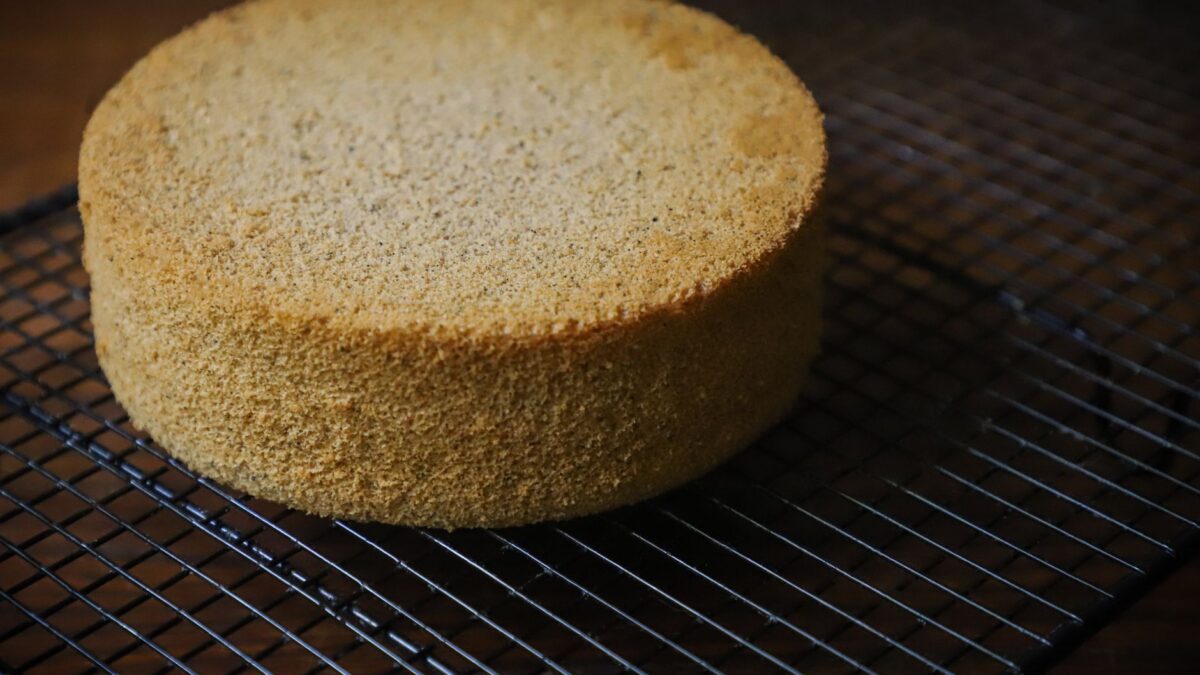
A cake sinks in the middle when its center collapses before the crumb has set firmly enough to hold the gas bubbles. The most common cause is underbaking; the next most common are too much leavening, an oven running cooler than the dial, and a pan that is too small for the batter. Most of these show clues you can read in the sunken cake itself.
How a cake rises and why it falls
As batter heats, gas from baking powder or soda and steam from the liquid expand the air bubbles you mixed in. At the same time, egg proteins and starch firm up into a solid structure. If heat reaches the center before the gas escapes, the cake sets in its risen shape. If the structure is still soft when the cake leaves the oven or the gas runs out, the center deflates. The same physics explains why muffins sink.
Causes and fixes at a glance
| Cause | Clues in the cake | Fix next time |
|---|---|---|
| Underbaked center | Gummy, dense or wet band in the middle; edges fine | Bake until a toothpick comes out clean and the center springs back; check internal temperature |
| Too much baking powder or soda | Rose high fast, then collapsed; coarse crumb, possible bitter or soapy taste | Level the measuring spoons; check the recipe amount per cup of flour |
| Old leavening | Never rose much; flat and dense all over | Test baking powder in warm water before baking |
| Oven too cool | Pale top, long bake, sunken and dense middle | Check with an oven thermometer and adjust the setting |
| Oven too hot | Dark crust, domed edges set early, raw sunken center | Lower the temperature to match the recipe; use a thermometer |
| Pan too small or too deep | Batter filled the pan high; center never set | Use the stated pan size; fill pans about half to two-thirds full |
| Oven door opened early | Cake fell soon after you checked it | Wait until at least two-thirds of the bake time has passed |
| Overbeaten batter | Big rise, then collapse; tunnels | Beat only as long as the recipe says, especially after adding eggs |
| Too much sugar or liquid | Sticky, dense top that sinks | Weigh ingredients; avoid adding extra fruit or syrup |
| High altitude | Repeated rise-and-fall at elevations above about 3,000 ft | Reduce leavening and adjust per altitude guidance |
The main causes in more detail
1. The center was underbaked
The edges of a cake set first because they are closest to the hot pan. A cake can look golden and smell done while the middle is still liquid. When it cools, that soft center cannot support itself. Bake times in recipes are estimates; ovens, pans and batter temperature all change them.
2. Leavening was off
Too much baking powder or soda inflates bubbles beyond what the batter can hold; they merge, rise to the surface and pop, and the cake falls. Too little, or leavening that has lost strength, gives a short, dense cake. The guide to baking powder vs baking soda explains how each one works and how to test freshness.
3. The oven temperature was wrong
Home ovens often run hotter or cooler than the dial, and many cycle up and down. A cool oven lets gas escape before the structure sets. A hot oven sets the outside too fast and the center rises late, then sinks. An inexpensive oven thermometer tells you the truth; see how to check oven temperature accuracy.
4. The pan was the wrong size
Batter that sits deeper than the recipe intended takes much longer to bake through. If you swapped an 8-inch pan for a 9-inch one (or the reverse), the depth and time change. The cake pan size conversion guide shows how to match volume and adjust timing.
How to tell when a cake is done
- Toothpick or skewer: insert it in the center. It should come out clean or with a few moist crumbs, not wet batter.
- Spring-back: press the center lightly with a finger. It should spring back rather than leave a dent.
- Edges: the cake should be just starting to pull away from the sides of the pan.
- Internal temperature: an instant-read thermometer in the center gives the clearest answer. Kansas State University Extension lists about 205–210°F (96–99°C) for layer cakes and about 210°F (99°C) for pound cake, with visual cues still important.
Start checking at the low end of the recipe’s time range, and close the door quickly to keep heat in.
Can you save a sunken cake?
Usually, yes. What you do depends on why it sank.
- If it is fully baked but dipped: level the top with a serrated knife and use the cake as a bottom layer, or fill the dip with frosting, whipped cream or fruit.
- If the center is slightly gummy: cut out the soft middle and turn the cake into a ring, or cube the baked parts for a trifle with cream and fruit.
- If you catch it right away: a cake that sank because it was underbaked can sometimes go back into the oven for 5–10 minutes if it is still warm, but the texture rarely fully recovers.
- Cake pops or crumbs: crumble any baked portions, mix with a little frosting, and shape into balls.
Discard any portion that is still raw batter in the center. Raw cake batter contains raw flour and usually raw egg, which the U.S. FDA advises against eating.
Prevention checklist
- Preheat fully and verify the temperature with an oven thermometer.
- Weigh flour, sugar and liquids, or spoon and level the flour.
- Level baking powder and soda with a straight edge.
- Use the pan size in the recipe and fill it no more than about two-thirds full.
- Bake on the middle rack and avoid opening the door during the first two-thirds of baking.
- Test doneness in the center, not near the edge.
- Cool in the pan on a rack for the time the recipe states before turning out.
Bottom line
Most sunken cakes were underbaked in the center. Use a toothpick, spring-back test and, if you can, a thermometer reading around 205–210°F. If the cake was fully baked and still fell, look at leavening amounts, oven accuracy and pan size. A sunken cake is almost always still usable with a little leveling and frosting.
FAQ
Why did my cake sink after I took it out of the oven?
Usually the center had not fully set, or the cake was overleavened. A small settling as a cake cools is normal; a deep crater is not.
Does opening the oven door make a cake fall?
Opening the door early, before the structure sets, lets heat escape and can cause a collapse. Late in the bake it is usually fine to check briefly.
Why does only my chocolate cake sink?
Many chocolate cakes are very moist and rely on soda reacting with cocoa. Too much soda, or an underbaked center, makes them especially prone to dipping.
Can a cake sink because of the pan color?
Indirectly. Dark pans bake edges faster, which can tempt you to pull the cake before the center is done. Check the center, not the edges.