Is Your Oven Running Hot or Cold? How to Check and Correct Oven Temperature
The number on the dial is a target, not a guarantee. A cheap oven thermometer and a simple test explain many over-browned muffins and sunken cakes.
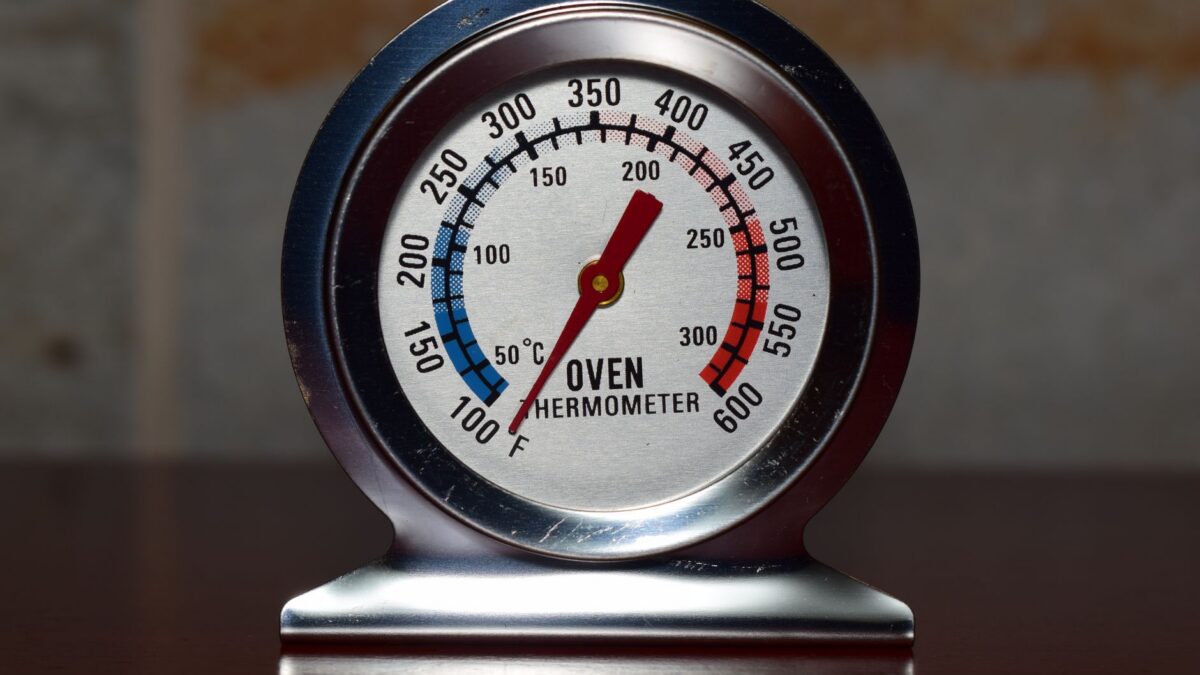
To check your oven’s accuracy, place an oven thermometer in the center of the middle rack, preheat to a set temperature such as 350°F (177°C), wait at least 15–20 minutes after the oven says it is ready, then read the thermometer several times over 10–15 minutes. If the average is consistently higher or lower than the dial, adjust your setting or the oven’s calibration. When you switch to convection, most manufacturers advise lowering the temperature by about 25°F (about 20°C on UK and Australian fan ovens).
Why ovens are often off
Home ovens heat in cycles. The element or burner turns on until the air passes the set temperature, turns off as it cools below, then switches on again. The average should be close to the dial, but the swing and the average both drift over time as sensors age, door seals wear and elements weaken. The “preheated” signal often comes on when the air near the sensor reaches temperature, before the walls and racks have caught up.
A difference of 25°F changes baking noticeably. A hot oven sets edges too fast, causing domed and cracked cakes and dark bottoms. A cool oven gives pale, dense bakes and centers that collapse, a common reason behind sinking muffins.
How to test your oven, step by step
- Get an oven thermometer. A dial or digital thermometer designed to stay in the oven is inexpensive. Probe thermometers with a cable and an air-temperature clip also work.
- Place it in the center of the middle rack, where most baking happens. Make sure you can read it through the window or quickly with the door open.
- Preheat to 350°F (177°C) with the rack positioned as you normally bake.
- Wait. Give the oven at least 15–20 minutes after the preheat signal so the walls and racks are hot.
- Take several readings about every 5 minutes for 15–20 minutes, opening the door as little as possible. Note the highest and lowest values.
- Average the readings. That average is what your oven really runs at for that setting.
- Repeat at another temperature, such as 425°F (218°C), because the error can differ across the range.
What to do with the result
| Average reading at a 350°F setting | What it means | What to do |
|---|---|---|
| Within about 10°F | Normal cycling | Bake as the recipe says |
| 15–25°F off | Runs noticeably hot or cool | Adjust your setting by the difference, or calibrate the oven |
| More than about 35°F off | Possible sensor or element problem | Check the manual’s calibration range; consider a service call |
| Swings widely (e.g. 50°F up and down) | Large cycling range | Use the average; preheat longer; a baking stone or heavy sheet on a lower rack can steady the temperature |
Many electronic ovens allow you to set a temperature offset in the settings menu, and many gas ovens have a calibration adjustment. The method and the allowed range depend on the model, so follow your manufacturer’s manual.
Finding hot spots
Most ovens are hotter near the back, the sides or the top element. A simple way to map them:
- Cover a baking sheet with slices of white sandwich bread, edge to edge.
- Bake on the middle rack at 350°F (177°C) for several minutes until the slices toast.
- Darker slices mark the hot zones.
Rotate pans front to back about two-thirds of the way through baking to even out browning, and avoid placing pans against the oven walls. Opening the door earlier than that can make cakes and muffins fall.
Rack position
- Middle rack: the default for cakes, muffins, quick breads and cookies; heat reaches the top and bottom most evenly.
- Lower third: pies and breads that need a well-browned bottom crust.
- Upper third: browning tops; also the place where cookies can scorch on top if the element is above.
- Two sheets at once: upper and lower thirds, swapping and rotating halfway through.
Convection and fan ovens
Convection ovens use a fan to move hot air, which speeds heat transfer and browning. Oven makers such as GE and Wolf generally advise reducing the recipe temperature by about 25°F for convection baking, or shortening the time; some recommend checking when about three-quarters of the normal time has passed. In the UK and Australia, recipes often list both a conventional and a “fan” temperature, with fan roughly 20°C lower. Delicate batters and custards can dry out or bake unevenly with a strong fan, so many bakers use conventional mode for cakes. The oven temperature conversion chart lists Fahrenheit, Celsius, fan and gas mark side by side.
Some ovens convert the temperature automatically in convection mode. Check the manual before subtracting 25°F yourself, or you may lower it twice.
Other things that change oven performance
- Pan color and material: dark and glass pans absorb more heat; appliance makers often suggest about 25°F lower.
- Overcrowding: too many pans block air flow and lower the effective temperature.
- Frequent door opening: each opening drops the air temperature, and recovery takes time.
- Altitude: above about 3,000 ft, recipes often need a slightly higher temperature and other changes; see high-altitude baking.
Bottom line
Do not trust the dial alone. Put a thermometer on the middle rack, preheat longer than the beep, average several readings and adjust or calibrate if the oven is off by more than about 15°F. Use the middle rack by default, rotate pans late in the bake, and lower the temperature about 25°F for convection unless your oven does it for you.
FAQ
How long should an oven preheat?
Wait until the preheat signal, then a further 10–20 minutes for cakes and breads so the walls and racks are fully hot. An oven thermometer shows when it is truly ready.
Where should an oven thermometer go?
In the center of the middle rack, away from the walls, where your pans normally sit.
Can I use a probe thermometer to check the oven?
Yes, if it has an air or oven clip and is rated for oven use. Keep the probe tip in the air, not touching metal.
Is 350°F the same as 180°C?
Exactly, 350°F is about 177°C. UK recipes round it to 180°C (160°C fan, gas mark 4).