Why Are My Muffins Dry? Causes, Doneness Cues and How to Keep Them Moist
Dry muffins come from a few predictable things: too long in the oven, packed flour, too little fat or sugar, and storage that lets moisture escape.
Muffins are usually dry because they were baked too long or the batter had too much flour, most often from packing it into a measuring cup. Cutting fat or sugar too far, a hot oven and leaving muffins uncovered after cooling also dry them out. Pulling them as soon as the center is set and storing them airtight fixes most cases.
Where the moisture goes
Batter is full of water from milk, eggs and fruit. During baking, some evaporates and some is absorbed by starch and held by sugar and fat. Every extra minute in the oven drives off more water, and the outer edges dry first. After baking, the crumb keeps losing moisture to the air, and the starch slowly firms up as it cools, a process called staling. A dry muffin is the sum of all these losses, so the fix usually involves more than one step.
Cause → fix table
| Cause | Clues | Fix |
|---|---|---|
| Overbaking | Dark edges, firm tops, crumbly interior | Start checking at the low end of the bake time |
| Packed or scooped flour | Stiff batter, tight crumb, short muffins | Weigh flour or spoon and level |
| Too little fat or sugar | Bland, bready, stale by the next day | Use the recipe amounts; reduce sugar by no more than about a quarter |
| Oven too hot | Browned outside, dry rim, center barely done | Check with an oven thermometer |
| Left in the hot pan too long | Firm, dry sides and bottoms | Move to a rack within about 5 minutes |
| Poor storage | Fine on day one, dry on day two | Cool fully, then store airtight or freeze |
Overbaking and carryover heat
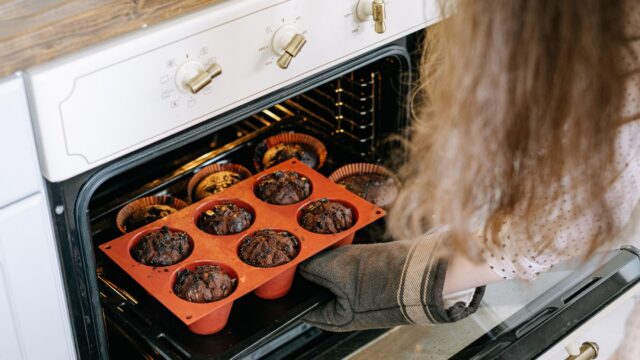
Muffins keep cooking for a few minutes after they come out, because the hot pan and the heat stored in the crumb continue to set the center. If you wait until a muffin feels completely firm in the oven, it will often be overdone by the time it cools.
Use these doneness cues together:
- Toothpick: inserted in the center, it comes out clean or with a few moist crumbs. Wet batter means more time.
- Spring-back: the top springs back when pressed lightly near the middle.
- Edges: the sides are just starting to pull away from the liner or pan.
- Temperature: about 200–205°F (93–96°C) in the center, the doneness range King Arthur gives for quick breads.
Start checking two or three minutes before the shortest time in the recipe. Our guide to how long to bake muffins lists typical times for mini, standard and jumbo sizes.
Too much flour
This is the hidden cause behind many dry muffins. A cup of all-purpose flour weighs 120 g by King Arthur’s weight chart, but a cup scooped straight from the bag and packed down can weigh considerably more. That extra flour absorbs liquid that should have kept the crumb moist. A kitchen scale is the most reliable fix. Without one, stir the flour to loosen it, spoon it into the cup and level the top. See how to measure flour for more detail.
Too little fat or sugar
Fat coats flour proteins, limiting gluten and keeping the crumb tender. Sugar is not only for sweetness: it attracts and holds water, which is why sweeter muffins stay moist longer. Reducing both at once is a common way to end up with dry, bready muffins. If you want to lighten a recipe, change one thing at a time and keep the reduction modest. Some bakers replace part of the fat with plain yogurt or applesauce, which adds moisture, but replacing all of it changes the texture noticeably.
Oil-based muffins tend to taste moister than butter-based ones, because oil stays liquid at room temperature while butter firms as it cools. Butter brings flavor, so many recipes balance the two.
Oven temperature
An oven running hot browns the outside quickly while the center catches up, and by the time the middle is done, the edges are dry. A standalone oven thermometer will reveal whether your dial is accurate. Dark pans also run hotter; many pan and mix makers suggest lowering the oven by about 25°F when using them.
Cooling and storing so muffins stay moist
- Let muffins rest in the pan for about 5 minutes so they firm up enough to lift out.
- Move them to a wire rack to finish cooling. Leaving them in the hot pan keeps baking the sides.
- Cool completely before covering, or trapped steam will make the tops sticky.
- Store in an airtight container at room temperature for a couple of days. Some bakers line the container with a paper towel to absorb excess moisture.
- For longer storage, wrap and freeze. Freezing slows staling far better than the refrigerator, which can actually make baked goods firm up faster. Our guide to freezing muffins covers wrapping and thawing, and how long muffins last covers shelf life.
Reviving a dry muffin
A slightly dry muffin can be warmed briefly in a low oven or microwave (a few seconds is enough) to soften the crumb. Splitting and toasting it with butter also works well. Very dry muffins are best turned into something else, such as a bread pudding or crumble topping.
Bottom line
Pull muffins as soon as the center tests done, measure flour by weight, keep the fat and sugar close to the recipe, and store them airtight once cool. Those four habits solve almost every dry-muffin problem.
FAQ
Can I add more liquid to fix dry muffins?
Only cautiously. If the real cause is too much flour or overbaking, extra liquid can make the batter thin and the muffins gummy. Fix measuring and timing first.
Do muffins dry out in the fridge?
Refrigeration tends to make the crumb firm and stale faster. Room temperature for a couple of days, or the freezer for longer, works better for most muffins.
Why are the edges dry but the middle is fine?
The oven is likely too hot, the pan is dark, or the muffins stayed in the hot pan too long after baking.
Does adding yogurt make muffins moister?
Yogurt or sour cream adds moisture and acidity, which tenderizes. Use recipes built around them, since they change how much leavening and liquid you need.