Banana Muffins: How Ripe the Bananas Should Be, Oil vs. Butter and the Best Add-Ins
Heavily speckled bananas do most of the work here. This standard recipe explains how ripe they should be, when to choose oil or butter and how much to add in.
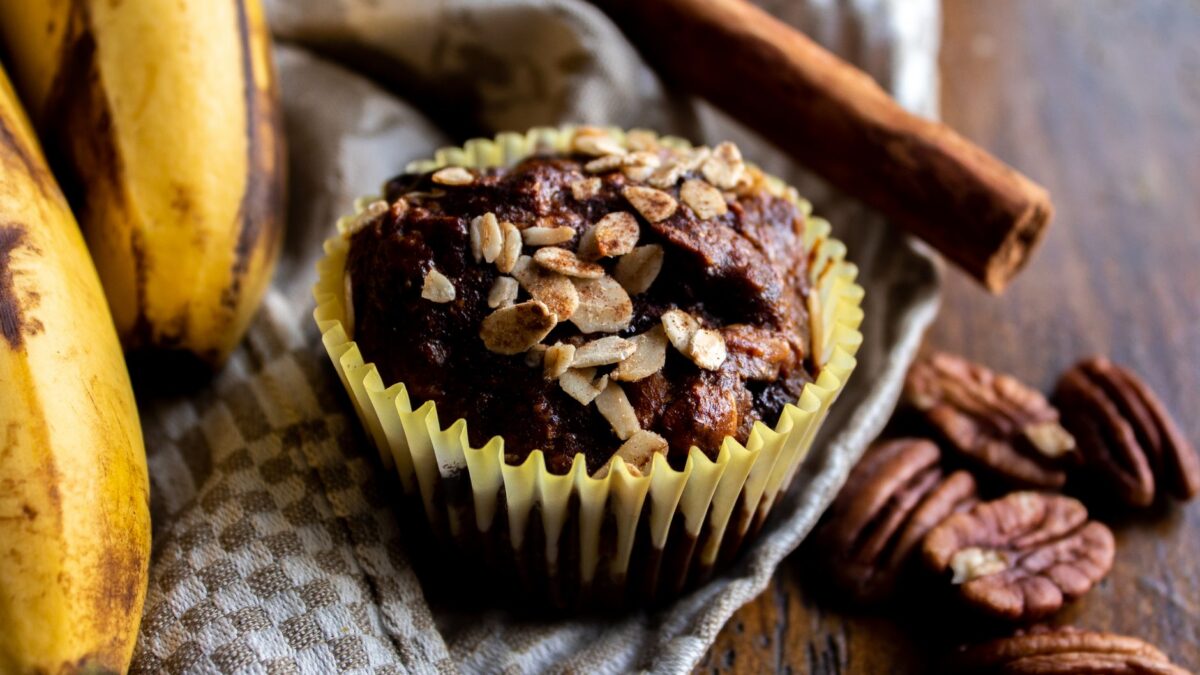
The best banana muffins start with very ripe bananas, heavily speckled or mostly brown, because ripening turns their starch into sugar and softens the flesh so it blends into the batter. A standard batch uses about 1 1/2 cups (340 g) of mashed banana, roughly 3 medium bananas, for 2 cups of flour. Bake at 375°F (190°C) for 18 to 22 minutes.
Bananas add moisture, sweetness and weight, so this batter uses less sugar and less liquid than a plain muffin. Weights below follow King Arthur’s convention of 120 g per cup of all-purpose flour and 227 g per cup of mashed banana.
How ripe should the bananas be?
| Peel color | Flavor and texture | For muffins? |
|---|---|---|
| Yellow with green tips | Starchy, mild, firm | Too early; flat flavor, lumps |
| Fully yellow | Sweet, still firm | Works, but mild |
| Yellow with many brown speckles | Sweet, soft, aromatic | Ideal |
| Mostly brown to black | Very sweet, very soft | Ideal; strongest banana flavor |
| Leaking, moldy or fermented smell | Spoiled | Discard |
Frozen bananas work well. Thaw them in a bowl, then use the fruit and the liquid that collects; that liquid is banana juice and belongs in the batter. Measure after thawing.
Need to speed things up? Bakers commonly roast unpeeled bananas on a sheet at 300°F (150°C) for about 15 to 20 minutes until the peels turn black. It softens them, but it does not create the same depth of flavor as natural ripening.
Ingredients (12 standard muffins)
- 2 cups (240 g) all-purpose flour
- 1 teaspoon baking soda
- 1/2 teaspoon baking powder
- 1/2 teaspoon fine salt
- 1/2 teaspoon ground cinnamon (optional)
- 1 1/2 cups (340 g) mashed very ripe banana (about 3 medium)
- 2/3 cup (142 g) packed light brown sugar, or 2/3 cup (132 g) granulated sugar
- 2 large eggs, at room temperature
- 1/3 cup (66 g) neutral oil, or 5 1/3 tablespoons (76 g) butter, melted
- 1/4 cup (57 g) plain yogurt, sour cream or milk
- 1 teaspoon vanilla extract
- Up to 1 cup add-ins (see the table below)
Method
- Heat the oven to 375°F (190°C), gas mark 5, or about 170°C fan. Line or grease a 12-cup muffin pan.
- Whisk the flour, baking soda, baking powder, salt and cinnamon in a bowl.
- In a larger bowl, mash the bananas with a fork until mostly smooth, with a few small lumps.
- Whisk the sugar, eggs, oil or butter, yogurt and vanilla into the bananas.
- Add the dry ingredients and fold with a spatula just until no dry flour remains. Fold in add-ins with a few more strokes.
- Fill the cups about three-quarters full to nearly full.
- Bake 18 to 22 minutes, until the tops spring back and a toothpick in the center comes out clean. Banana batter browns quickly because of its sugar, so judge doneness by the center, not by color.
- Cool 5 minutes in the pan, then transfer to a rack.
Why it works
Baking soda pairs with the bananas and sugar. Ripe bananas, brown sugar and yogurt are mildly acidic, and baking soda needs an acid to produce carbon dioxide. A little baking powder adds backup lift. Too much soda leaves a soapy taste and very dark muffins, which is why the amount stays at about 1/2 teaspoon per cup of flour or less. For the chemistry, see baking powder vs. baking soda.
Bananas count as liquid. Mashed banana is mostly water. Adding more banana than the recipe calls for makes the batter heavier and wetter, which leads to dense, gummy centers, the same issue that affects banana bread.
Brown sugar adds moisture. Its molasses content holds water and deepens the caramel notes that suit banana. White sugar gives a lighter color and slightly drier crumb.
Oil vs. butter in banana muffins
| Oil, 1/3 cup (66 g) | Melted butter, 1/3 cup (76 g) | |
|---|---|---|
| Texture | Softer, moister, stays tender for days | Slightly firmer, more cake-like |
| Flavor | Lets banana dominate | Richer, buttery |
| Next-day quality | Very good | Firmer from the fridge; rewarm briefly |
| Dairy-free | Yes, if you also skip yogurt or milk | No |
You can also split the fat half and half. More detail on swapping amounts is in oil vs. butter in muffins.
Add-ins and amounts
| Add-in | Amount for 12 muffins | Tip |
|---|---|---|
| Chocolate chips | 3/4–1 cup (128–170 g) | Mini chips spread more evenly |
| Chopped walnuts or pecans | 3/4 cup (85 g) | Toast first for more flavor |
| Rolled oats | 1/2 cup (45 g), replacing 1/4 cup (30 g) flour | Adds chew; let batter rest 10 minutes |
| Blueberries | 3/4 cup (105–128 g) | Add frozen; batter is already wet |
| Peanut butter swirl | 1/4 cup (about 65 g), warmed | Dollop on top and swirl with a knife |
Keep total add-ins to about 1 cup. Beyond that, the batter cannot hold them and the muffins crumble.
Storage and freezing
Cool completely, then store loosely covered at room temperature. Banana muffins are moist, so bakers commonly eat them within 2 to 3 days and freeze the rest. Freeze in an airtight bag, then thaw at room temperature or warm for a few minutes in a 300°F (150°C) oven.
Troubleshooting
| Problem | Likely cause | Fix |
|---|---|---|
| Gummy or wet center | Too much banana, underbaked | Measure banana; bake until toothpick is clean |
| Dark tops, raw middle | Oven too hot or too much sugar | Check oven temperature; lower to 350°F and bake longer |
| Bitter or soapy taste | Too much baking soda, poorly mixed | Measure level spoons; whisk dry ingredients well |
| Bland flavor | Underripe bananas | Wait for heavy speckling, or freeze ripe bananas ahead |
| Dense and heavy | Overmixing, scooped flour | Fold briefly; weigh flour or spoon and level |
Food safety and allergens
Do not taste raw batter; the FDA advises against eating raw flour or raw eggs, and baking makes them safe. These muffins contain wheat, eggs and milk (if using butter or yogurt), and tree nuts or peanuts if you add them. For nut-free or gluten-free baking, use certified ingredients and keep cross-contact in mind, and follow medical advice if anyone has an allergy.
Bottom line
Use bananas that are speckled or brown, measure them rather than adding “a few extra,” choose oil for moisture or butter for flavor, and cap add-ins at about a cup. Bake until the center tests clean, not until the tops look done.
FAQ
How many bananas make 1 1/2 cups mashed?
Usually 3 medium or 4 small bananas. Sizes vary, so measuring by volume or weight (340 g) gives more consistent results.
Can I turn this into banana bread?
Yes. Bake it in a greased 9 x 5-inch loaf pan at 350°F (180°C) for about 55 to 65 minutes, tenting with foil if the top browns early. See our banana bread guide for loaf-specific tips.
Can I make them without eggs?
Bananas already bind well, so one egg can often be replaced with 1/4 cup (60 g) of yogurt or applesauce. Replacing both eggs gives a denser, more fragile muffin.
Why did my muffins turn out dark brown?
Ripe bananas and brown sugar caramelize quickly, and extra baking soda darkens the crumb further. Check the oven temperature and measure the soda carefully.