How to Get Tall, Domed Muffin Tops: 5 Steps and Why Each One Works
Bakery-style domes are not a secret ingredient. They come from batter thickness, how full you fill the cups and how the first minutes of baking go.
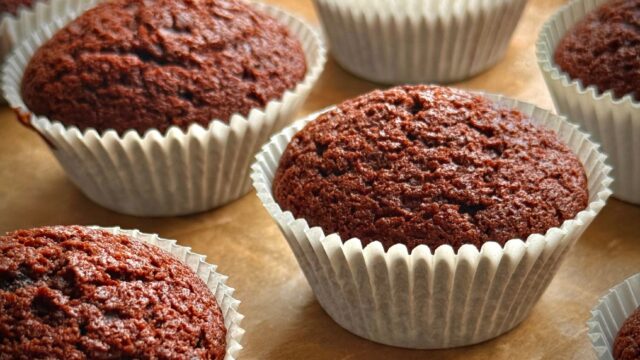
To get tall, domed muffin tops, use a thick batter, fill the cups almost to the top and start baking in a hot oven, commonly 425°F (220°C) for about 5 minutes, then lower the heat to around 350°F (175°C) without opening the door to finish. Fresh baking powder and a short batter rest help too. Each step works on the same idea: make the batter rise up quickly before the outside sets.
How a muffin dome forms
In the oven, the batter touching the pan heats first and sets into a firm wall. The center stays liquid longer, so as gas and steam expand, the only direction left to go is up. The dome is the center pushing upward through a ring of already-set batter. A taller dome needs two things: enough batter to push upward, and fast early expansion so the center rises before the top crust forms.
The five steps
1. Make the batter thick
A thick, scoopable batter holds its shape and stacks up in the cup, so it rises upward rather than spreading. A thin, pourable batter levels out and bakes flat. Thickness comes from the ratio of flour to liquid, so measure flour accurately (King Arthur’s chart uses 120 g per cup of all-purpose flour) and avoid adding extra milk to loosen the batter. Batters made with thick dairy like sour cream or Greek yogurt are naturally stiffer.
2. Fill the cups fuller
Many recipes say to fill cups two-thirds full, which gives a modest top. For bakery-style domes, bakers commonly fill the cups to the rim or just below. To do that without overflowing, you either make more batter or fill fewer cups: a 12-muffin batter spread across 9 or 10 cups gives noticeably taller tops. Fill empty cups halfway with water, or leave them empty, so the pan heats evenly. Bake times will run a few minutes longer for larger muffins.
3. Start hot, then lower the heat
A hot start gives the leavening a fast burst of gas and steam before the top sets. The widely used version is to preheat to 425°F (220°C), bake about 5 minutes, then turn the oven down to 350°F (175°C) for the rest of the bake, keeping the door closed. The lower temperature lets the center cook through without burning the outside.
| Phase | Temperature | What it does |
|---|---|---|
| First ~5 minutes | 425°F / 220°C (gas 7; about 200°C fan) | Rapid gas expansion and oven spring; lifts the dome |
| Remaining time | 350°F / 175°C (gas 4; about 160°C fan) | Sets the center evenly without over-browning |
| Total, standard size | Typically 18–25 minutes | Check with a toothpick from about 15 minutes in |
Ovens differ, so check doneness rather than relying only on time. A single steady temperature of 400°F (200°C) also produces a good dome in many recipes.
4. Rest the batter
Some bakers let muffin batter rest, covered, for 20–30 minutes at room temperature or longer in the fridge before baking. Resting gives flour time to absorb liquid, which thickens the batter. Double-acting baking powder releases most of its gas in the oven, so a short rest does not waste much rise. Batters leavened with baking soda alone are less forgiving and are best baked soon after mixing. If you chill batter, keep it covered and bake it within the time the recipe allows.
5. Use fresh baking powder and mix briefly
Old baking powder gives a sluggish rise and flatter tops. Clabber Girl recommends using an opened can within about six months. Mix the batter just until no dry flour remains; the muffin method explains why. Overmixing tends to produce a sharp, narrow peak with tunnels inside rather than a smooth dome.
Pan choice matters
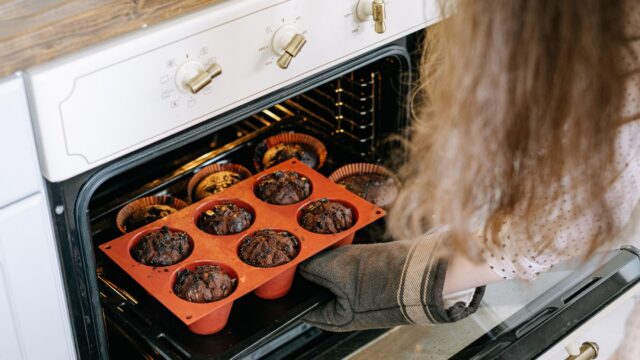
Metal pans conduct heat quickly and set the sides fast, which helps the batter climb. Light-colored aluminized steel or aluminum gives even browning. Silicone pans heat more slowly, so muffins in silicone often have softer sides and lower tops. Our guide to choosing muffin pans covers materials and sizes.
What makes tops flat or overflow
- Flat tops: thin batter, underfilled cups, weak leavening or an oven that has not fully preheated. See why muffins have flat tops.
- Mushroom tops that spill over: cups overfilled with a thin batter. Leave a little space or fill fewer cups.
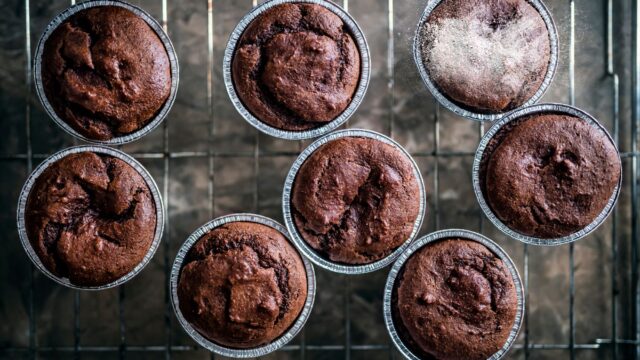
- Cracked domes: a crack along the top is normal with a hot start; it shows the center pushed up after the surface set.
- Sharp peaks: overmixing or a very hot oven for the entire bake.
Finishing touches
A spoonful of coarse sugar or streusel on top adds crunch and makes domes look fuller, but heavy streusel can weigh down a delicate top. Scatter a few berries or chips over the surface rather than pressing them in.
Bottom line
Tall muffin tops come from physics rather than special ingredients: a thick batter, well-filled cups, fresh leavening and a hot start followed by a lower temperature. Change these one at a time to see which makes the biggest difference in your oven.
FAQ
Should I open the oven to lower the temperature?
No. Turn the dial down and leave the door closed. The oven will cool gradually, which is what you want.
Does this work for mini and jumbo muffins?
The ideas are the same, but times change. Mini muffins bake quickly and may need only a few minutes at the higher temperature; jumbo muffins need a longer finish at the lower one.
Will resting batter overnight ruin it?
Many batters with double-acting baking powder tolerate a covered overnight rest in the fridge, but some lose rise. Follow the recipe and refrigerate rested batter.
Why are my convection-baked muffins less domed?
Moving air can set the surface sooner. Many manufacturers suggest lowering the temperature by about 25°F on convection.