How Long Do Muffins Last? Room Temperature, Fridge and Freezer Guide
Muffins are best on day one and good for a few days after. How you store them decides whether they go stale, sticky or moldy first.

Most homemade muffins keep for about 2–4 days at room temperature in an airtight container, and for about 2–3 months in the freezer for best quality. The refrigerator is usually the worst choice for plain muffins, because cold makes them stale faster. Muffins with perishable fillings or toppings, such as cream cheese, cheese and meat, are the exception: refrigerate those within 2 hours of baking.
Storage times at a glance
| Muffin type | Room temperature | Refrigerator | Freezer (best quality) |
|---|---|---|---|
| Plain, chocolate chip, spice | 2–4 days | Not recommended (stales) | 2–3 months |
| Fresh fruit (blueberry, apple) | 2–3 days | Up to about a week in warm, humid weather | 2–3 months |
| Vegetable (zucchini, carrot, pumpkin) | 2–3 days | Up to about a week | 2–3 months |
| Cream cheese filling or frosting | No more than 2 hours | 3–4 days | 2–3 months |
| Savory with cheese or meat | No more than 2 hours | 3–4 days | 2–3 months |
These are typical ranges, not guarantees. Warm, humid kitchens shorten them; cool, dry ones lengthen them. Room-temperature times reflect common baking guidance for home muffins. The 2-hour rule and 3–4 day refrigerator window follow standard USDA guidance for perishable food and leftovers. Freezer times follow extension service guidance (NC State, University of Illinois) for baked goods.
Why muffins go bad the way they do
Staling
Staling is not drying alone. After baking, the starch in the crumb slowly recrystallizes and firms up, a process called retrogradation. It happens fastest at refrigerator temperatures, which is why a plain muffin can taste staler after a night in the fridge than after a day on the counter. Freezing almost stops it, which is why frozen muffins taste fresher once thawed. Muffins that were overbaked or low in fat will stale sooner; see why muffins are dry.
Stickiness
Muffins keep releasing moisture as they sit. In a sealed container, that moisture collects on the tops, turning sugar crusts and streusel sticky. A paper towel helps (see below).
Mold
Moist, low-acid baked goods are a good home for mold, especially at warm room temperatures. Fruit and vegetable muffins, which hold more water, usually mold sooner than plain ones.
How to store muffins on the counter
- Cool completely on a rack before covering. Covering warm muffins traps steam and makes them soggy and more prone to mold. This is also the fix for soggy muffin bottoms.
- Line an airtight container with a paper towel, set the muffins in a single layer, and lay another paper towel on top before closing the lid. The towels absorb excess moisture.
- Keep the container somewhere cool, away from the stove, dishwasher and sunny windows.
- Check daily. Replace damp paper towels, and look for any mold.
- Freeze what you will not eat within two days. Freezing on day one gives the best results later; see how to freeze muffins.
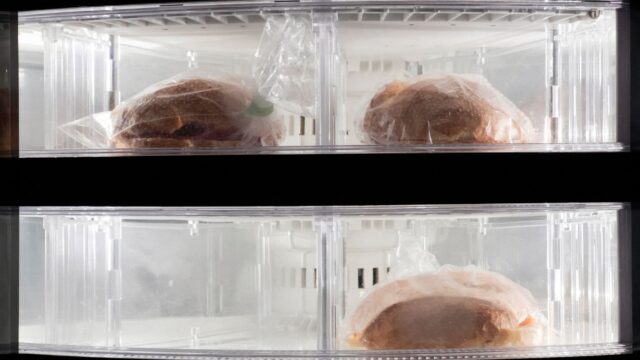
When to use the refrigerator
- Perishable fillings or toppings: cream cheese, custard, whipped cream, cheese, meat or egg-based fillings.
- Very warm, humid conditions, where muffins would mold within a day or two on the counter.
- Muffins made with a lot of fresh fruit or vegetables if you want them to last past the third day and do not want to freeze them.
Store refrigerated muffins in an airtight container and warm them briefly before eating, which softens the crumb again.
How to tell a muffin has gone bad
- Visible mold, often fuzzy white, green or blue spots. Discard the whole muffin. Baked goods are porous, so mold can spread below the surface where you cannot see it; USDA-based extension guidance lists bread and baked goods as foods to throw away, not trim. The USDA’s guide to molds on food also advises not to sniff moldy food, since spores can be inhaled.
- Off smell, such as sour, musty or fermented.
- Slimy or wet patches that were not there before.
- Muffins in the same container as a moldy one may also be contaminated; check them carefully and throw out any that touched it.
A muffin that is simply firm and dry is stale, not spoiled. Warm it in the oven, split and toast it, or use it in bread pudding.
Reviving stale muffins
- Oven: wrap loosely in foil and warm at about 300–350°F (150–180°C) for 5–10 minutes.
- Microwave: 10–15 seconds with a damp paper towel draped over the muffin. Eat right away; microwaved muffins firm up again as they cool.
- Toaster or skillet: slice in half and toast the cut sides, with a little butter if you like.
Bottom line
Keep plain and fruit muffins on the counter in an airtight, towel-lined container for 2–4 days, freeze anything you will not eat in that time, and refrigerate only muffins with perishable fillings. Throw away any muffin with mold rather than cutting it off.
FAQ
Do muffins need to be refrigerated?
Plain, fruit and chocolate muffins do not, and the fridge makes them stale faster. Refrigerate muffins with cream cheese, cheese, meat or other perishable fillings.
How long do blueberry muffins last?
About 2–3 days at room temperature, longer in the fridge in humid weather, and 2–3 months frozen for best quality.
Can I cut mold off a muffin and eat the rest?
No. Baked goods are soft and porous, so mold can reach deeper than you can see. Throw the muffin away.
Why do my stored muffins get sticky on top?
Moisture from the muffins collects in the sealed container. Line it with paper towels and make sure the muffins are completely cool before closing the lid.