How to Halve or Double a Baking Recipe: Eggs, Leavening, Pans and Bake Time
Scaling a recipe is simple arithmetic until you hit 1/3 cup, a single egg or a 9x13 pan. Here is how to handle each of those cleanly.
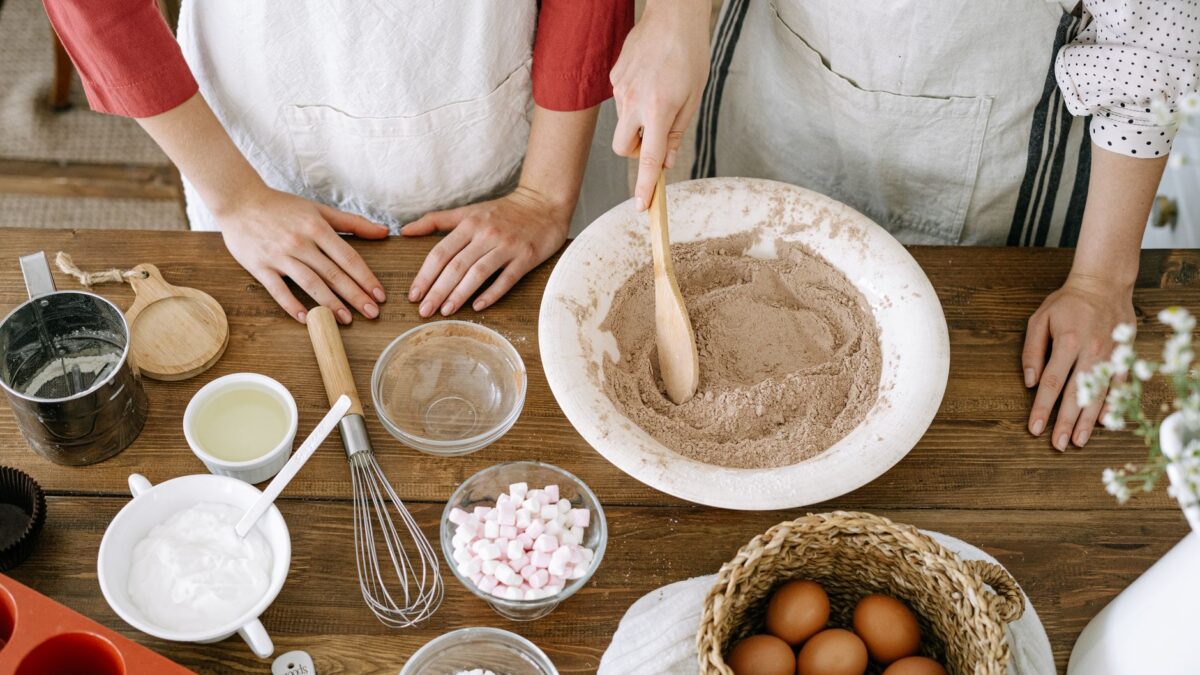
To halve a baking recipe, divide every ingredient by two (weighing is easiest), beat the eggs and use half by weight (a large egg is about 50 g out of the shell, so half is about 25 g), choose a pan with about half the area and keep the same oven temperature. Bake time stays similar if the batter depth is the same, and drops if the batter is shallower. Doubling works the same way in reverse, with a few extra cautions about mixing and pan crowding.
Step by step: halving a recipe
- Convert the recipe to grams if you can. Halving 240 g of flour is easier than halving 2 cups minus 2 tablespoons. Use the cups to grams chart if needed.
- Divide each ingredient by two and write the new amounts down before you start.
- Handle the eggs as described below.
- Scale leaveners, salt and spices exactly. Halve them like everything else; do not round up “to be safe”.
- Pick a pan with roughly half the area of the original.
- Bake at the original temperature and start checking for doneness early.
Halving cups and spoons
| Original | Half |
|---|---|
| 1 cup | 1/2 cup |
| 3/4 cup | 6 tablespoons |
| 2/3 cup | 1/3 cup |
| 1/2 cup | 1/4 cup |
| 1/3 cup | 2 tablespoons + 2 teaspoons |
| 1/4 cup | 2 tablespoons |
| 1 tablespoon | 1 1/2 teaspoons |
| 1 teaspoon | 1/2 teaspoon |
| 1/2 teaspoon | 1/4 teaspoon |
| 1/4 teaspoon | 1/8 teaspoon |
| 1/8 teaspoon | a scant pinch (about 1/16 tsp) |
One US tablespoon equals 3 teaspoons, and one cup equals 16 tablespoons; every row above follows from those two facts.
Eggs: the tricky part
A recipe with one egg becomes a recipe with half an egg. You cannot crack half an egg, but you can measure one:
- Crack the egg into a small bowl and beat it until the white and yolk are fully mixed.
- Weigh it (a large egg is typically about 50 g without the shell, per King Arthur Baking’s weight chart) and use half, about 25 g. Without a scale, a beaten large egg is a little over 3 tablespoons, so use about 1 1/2 tablespoons.
- Cover and refrigerate the leftover egg promptly and cook it within a day or two, for example in scrambled eggs.
For three eggs halved (1 1/2 eggs), use one whole egg plus half of a second beaten egg, or one whole egg plus one yolk if you prefer a slightly richer result. For egg safety when handling raw eggs, see raw eggs in baking.
Choosing the right pan
| Full recipe | Half recipe | Double recipe |
|---|---|---|
| 12 standard muffins | 6 standard muffins | 24 muffins (two pans) |
| 9 x 13-inch pan (117 sq in) | 8-inch square (64 sq in) | Half sheet, 18 x 13 (234 sq in) |
| Two 9-inch rounds | One 9-inch round | Four 9-inch rounds |
| 9-inch round | 6-inch round (about 44% of the area) | Two 9-inch rounds |
| 9 x 5-inch loaf | Mini loaves or 6 standard muffins | Two loaf pans |
Halving a 9 x 13 into an 8-inch square gives a slightly thinner layer (the square is a bit more than half the area), so start checking a few minutes early. For full area comparisons, see cake pan size conversions; for muffin sizes, see muffin pan sizes.
Bake time: what really changes
- Same pan type, same depth (6 muffins instead of 12, one layer instead of two): time stays about the same.
- Shallower batter: shorter time. Check 5–10 minutes early for cakes.
- Deeper batter (a doubled recipe in one big pan): noticeably longer, with a risk of dry edges and an underbaked center. Two pans of normal depth are safer.
- Temperature stays the same in all of these cases.
Doubling: extra things to watch
- Mixer and bowl capacity. Doubled batter may overflow a small bowl or overwork a hand mixer. Mix in two batches if needed; for muffins, a big bowl and a spatula are all you need.
- Do not overmix. A larger volume takes more strokes to combine, and muffin batter becomes tough if you keep going. Stop as soon as no dry flour shows.
- Leavening. For the batch sizes home bakers make, doubling baking powder and soda exactly is the standard approach.
- Oven space. Two pans on one rack need room for air to move. If you use two racks, swap and rotate the pans about two-thirds of the way through.
- Waiting batter. Batter for a second batch can wait while the first bakes. Many muffin batters made with double-acting baking powder tolerate a short wait; recipes using only baking soda are best baked promptly.
A kitchen scale makes all of this easier, since you can tare the bowl and add each ingredient directly.
Bottom line
Scale by weight, split eggs by beating and weighing, match the pan to the new amount of batter, and keep the oven temperature the same. Watch the depth of batter rather than the clock: the same depth means about the same time.
FAQ
How do I halve one egg?
Beat the egg, then use half: about 25 g, or roughly 1 1/2 tablespoons for a large egg.
Do I halve the baking time when I halve a recipe?
No. Time depends on how deep the batter is, not how much there is. Six muffins bake in about the same time as twelve.
Can I double a recipe in one deeper pan?
It is risky. The center bakes slowly and the edges can dry out. Use two pans of the original size or one pan with double the area.
What pan should I use for half a 9×13 recipe?
An 8-inch square is the closest common match. A 9-inch round also works, with slightly thinner results.