How Long to Let Bread Dough Rise: First and Second Rise Times
Bread dough needs 1 to 2 hours for the first rise and 30 to 60 minutes for the second at room temperature. Times by temperature, plus how to test it.
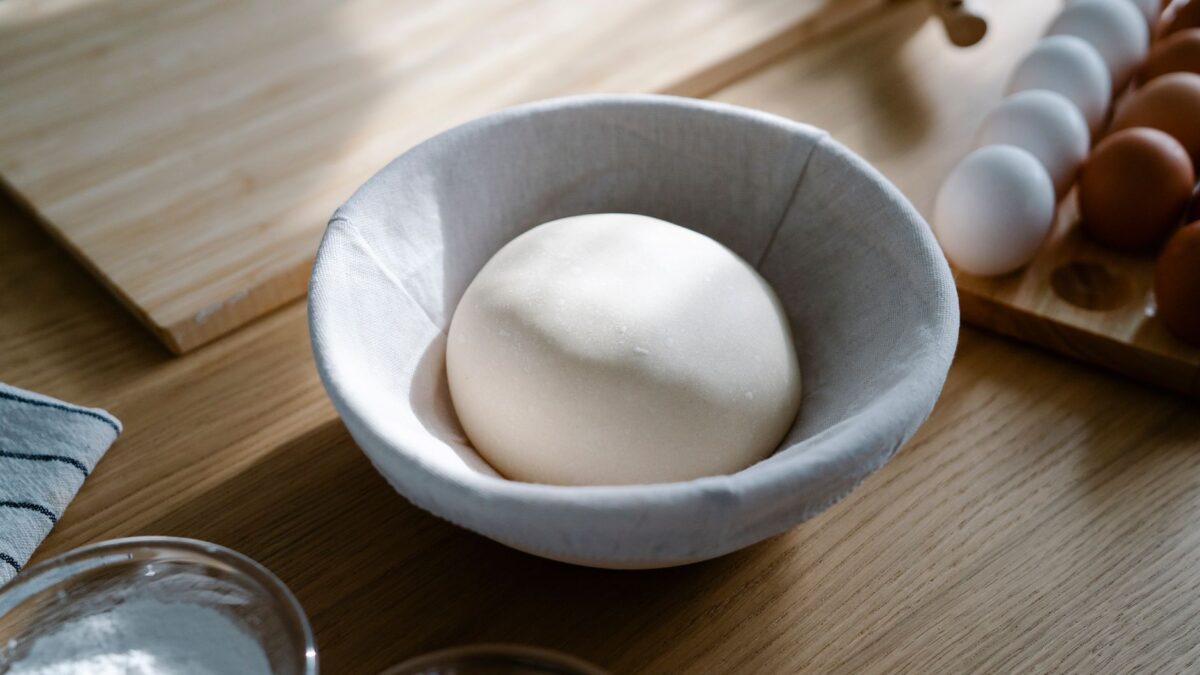
Bread dough made with yeast usually needs 1 to 2 hours for the first rise and 30 to 60 minutes for the second rise at a room temperature of about 75°F (24°C). A cooler kitchen stretches both times and a warmer one shortens them. In the refrigerator, the first rise takes 8 to 12 hours. The clock is only a guide: the first rise is finished when the dough has roughly doubled, and the second when a floured fingertip leaves a dent that springs back slowly.
How long does bread dough take to rise at different temperatures?
Rise time depends mostly on the temperature of the dough. Yeast works fastest when the dough is warm and slows down sharply as it cools. The ranges below are for a standard lean sandwich or white loaf made with the usual amount of instant or active dry yeast.
- Refrigerator, about 40°F (4°C): 8 to 12 hours for the first rise, up to overnight. The second rise after shaping takes 1 to 2 hours at room temperature, since the dough starts out cold.
- Cool room, 60 to 65°F (16 to 18°C): 2 to 4 hours for the first rise, 1 to 1 1/2 hours for the second.
- Average room, 68 to 72°F (20 to 22°C): 1 1/2 to 2 hours for the first rise, 45 to 75 minutes for the second.
- Warm room, 75 to 80°F (24 to 27°C): 1 to 1 1/2 hours for the first rise, 30 to 60 minutes for the second.
- Very warm spot, 85 to 90°F (29 to 32°C): 45 to 60 minutes for the first rise, 20 to 40 minutes for the second. Dough can overproof quickly at this temperature, so check it early.
Most bakers aim for 75 to 80°F (24 to 27°C). Dough rises at a steady pace in that range and still has time to develop flavor.
What is the difference between the first and second rise?
The first rise happens in the bowl right after kneading, and the second happens after the dough is shaped. The first one, also called bulk fermentation, is where most of the flavor develops and where the gluten relaxes and strengthens. The dough should about double in volume.
After the first rise the dough is pressed down gently, shaped into a loaf or rolls, and left to rise again. This second rise, often called proofing, refills the shaped dough with gas so the bread bakes up light. It is shorter, usually half to two thirds as long as the first, because the yeast population has grown and the dough is already active. A shaped loaf is ready when it has grown by about half to nearly double. In a standard loaf pan, the top of the dough sits about 1 inch (2.5 cm) above the rim.
How do you know when dough has risen enough?
Use the poke test instead of the timer. Flour a finger and press it about 1/2 inch (1 cm) into the dough.
- The dent springs back right away: the dough is underproofed and needs more time.
- The dent fills in slowly and only partway: the dough is ready.
- The dent stays put, or the dough sighs and sinks: it is overproofed.
For the first rise, a straight-sided container makes doubling easy to see. Mark the starting level on the outside with tape or a rubber band, then wait until the dough reaches twice that height.
What happens if dough rises too long or not long enough?
Underproofed dough bakes into a dense, tight loaf, and overproofed dough collapses. A loaf that went into the oven too soon often tears along the side as it expands and has a heavy, gummy crumb.
When dough is left too long, the gluten stretches past what it can hold. The loaf may deflate when it is slashed or moved, bake up flat, and taste sour or boozy. If the first rise went over, press the dough down, reshape it and let it rise again; it usually recovers. An overproofed shaped loaf can be handled the same way: knead it briefly, reshape it and give it a shorter second rise.
Where is the best place to let dough rise?
The best spot is draft-free and holds 75 to 80°F (24 to 27°C). Cover the bowl with a lid, a plate or a damp towel so the surface does not dry into a skin. Good options in a cool kitchen:
- An oven that is switched off, with only the light on. Check the temperature first, because some oven lights push it above 90°F (32°C).
- An oven that is switched off, with a pan of hot tap water on the rack below the dough.
- A microwave with the door shut and a mug of just-boiled water next to the bowl.
- The top of the refrigerator or a spot near a warm appliance, though never directly on a hot surface.
Avoid anything hotter than about 100°F (38°C). The dough rises fast at that temperature but tastes flat, and yeast starts to die at around 130 to 140°F (54 to 60°C).
Can you let bread dough rise overnight in the fridge?
Yes, most yeast doughs can do their first rise in the refrigerator for 8 to 12 hours, and many hold well for up to 24 hours. The cold slows the yeast, which gives the dough a deeper flavor and lets you split the work over two days. Use a container with room for the dough to double, and cover it tightly.
The next day, shape the dough while it is still cold, then let it proof at room temperature until it passes the poke test. That takes longer than usual, often 1 to 2 hours. Enriched doughs with butter, eggs and sugar, such as brioche or cinnamon rolls, are easier to shape cold and are often chilled overnight for that reason.
What else changes rise time besides temperature?
The amount of yeast, the ingredients and the dough’s moisture all change the timing.
- More yeast means a faster rise. Recipes that use very little yeast are designed for long, slow rises.
- Sugar, butter, eggs and milk slow the yeast in large amounts, so enriched doughs can take 1 1/2 to 2 times as long as lean ones.
- Salt slows fermentation. Dough made without it rises fast and tastes bland.
- Whole wheat and rye doughs often rise faster but less high, and they overproof more easily.
- Wetter doughs ferment faster than stiff ones.
- Sourdough runs on wild yeast and is much slower: the first rise commonly takes 4 to 12 hours at room temperature.
Quick breads work differently. A loaf such as classic banana bread is leavened with baking soda or baking powder and goes straight into the oven with no rising time at all. The same is true of muffins, which is why muffin baking times depend only on pan size and oven temperature.
Quick answers
Can dough rise too long on the counter?
Yes. At room temperature most doughs start to overproof after about 3 to 4 hours. If you need more time, move the bowl to the refrigerator before the dough has doubled.
Does bread dough need a second rise?
For most loaves, yes. Shaping pushes out much of the gas, and without a second rise the bread bakes up dense. A few no-knead and batter breads are written with a single rise.
Is instant yeast faster than active dry yeast?
Slightly. Instant yeast can shorten the rise by 10 to 15 minutes, and it is mixed straight into the flour. Active dry yeast is usually dissolved in warm water first.
Why is my dough not rising?
The usual causes are a cold kitchen, expired yeast, or liquid hot enough to kill the yeast. Move the dough somewhere warmer and give it more time before starting over.