High-Altitude Baking: How to Adjust Muffin, Quick Bread and Cake Recipes Above 3,000 Feet
Lower air pressure makes batters rise fast and then collapse. A few small, standard adjustments fix most problems, and muffins need the fewest.
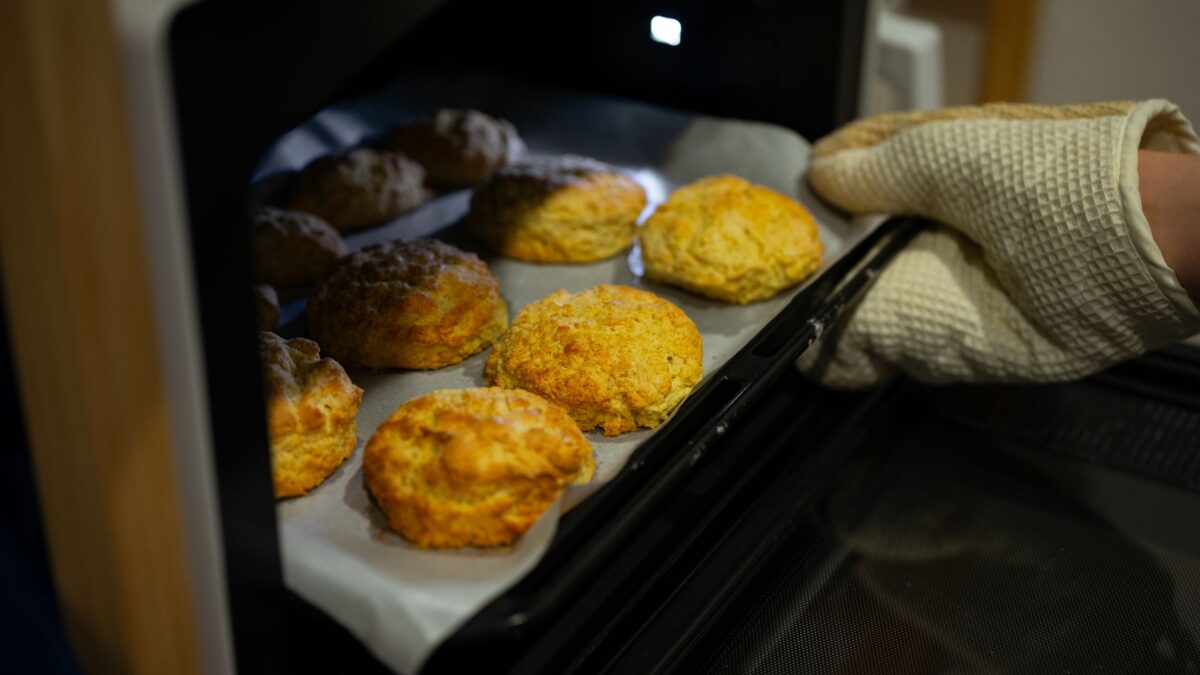
Above about 3,000 feet (915 m), most recipes developed at sea level need small changes: less baking powder or soda, a little less sugar, a little more liquid and an oven about 15–25°F (8–14°C) hotter, with a slightly shorter bake. Muffins and other quick breads are the most forgiving; cakes need the most care. Change one thing at a time and keep notes.
The figures below come from the high-altitude guidance published by King Arthur Baking and from Colorado State University Extension, which has advised home bakers in mountain states for decades.
Why altitude changes baking
Air pressure falls as elevation rises. That has three effects in the oven:
- Gases expand more. The carbon dioxide from baking powder and soda, and the steam from liquids, push bubbles bigger and faster. Batter can overrise before its structure sets, then collapse. That is one of the classic reasons muffins sink in the middle.
- Water boils at a lower temperature. According to USDA food safety guidance, the boiling point drops by just under 1°F for every 500 feet, so at 7,500 feet water boils at about 198°F instead of 212°F. Moisture evaporates sooner, which can dry baked goods out and concentrate the sugar in the batter.
- Concentrated sugar weakens structure. More sugar relative to water slows the setting of the crumb, making collapse more likely in rich cakes.
The fixes all aim at the same thing: help the batter set before the bubbles grow too large.
General adjustment chart
| What to change | Adjustment | Why |
|---|---|---|
| Oven temperature | Increase 15–25°F; use the lower increase for chocolate or delicate cakes | Sets the structure sooner |
| Baking time | Decrease by 5–8 minutes per 30 minutes of baking | The hotter oven finishes sooner |
| Sugar | Decrease by about 1 tablespoon per cup | Less sugar strengthens the crumb |
| Liquid | Increase by 1–2 tablespoons at 3,000 ft, plus 1 1/2 teaspoons for each additional 1,000 ft | Offsets faster evaporation |
| Flour | At 3,500 ft, add 1 tablespoon per recipe; add 1 more for each additional 1,500 ft | Adds structure |
| Baking powder or soda | Reduce (see next table) | Prevents overrising and collapse |
Source: King Arthur Baking high-altitude chart. Treat these as starting points; your recipe, pan and oven matter too.
Leavening reduction chart
| Recipe calls for | 3,000–5,000 ft | 5,000–6,500 ft | 6,500–8,000 ft |
|---|---|---|---|
| 1 tsp | 7/8 tsp | 1/2 tsp | 1/4 tsp |
| 1 1/2 tsp | 1 1/4 tsp | 3/4 tsp | 1/2 tsp |
| 2 tsp | 1 1/2 tsp | 1 tsp | 3/4 tsp |
| 2 1/2 tsp | 1 3/4 tsp | 1 1/4 tsp | 1 tsp |
| 3 tsp (1 tbsp) | 2 tsp | 1 1/4 tsp | 1 tsp |
Applies to baking powder or baking soda, per King Arthur Baking. 7/8 teaspoon is 3/4 teaspoon plus 1/8 teaspoon. If you are unsure which leavener does what in your recipe, read baking powder vs baking soda first.
Muffins and quick breads: start small
Colorado State University Extension notes that biscuits and muffin-type quick breads usually have a firm enough structure to cope with altitude, but that too much leavener can leave a bitter or alkaline taste. King Arthur likewise describes banana and zucchini breads as fairly resilient. So for muffins, try this order:
- Reduce the leavener using the chart above. This alone fixes many muffin recipes.
- Raise the oven 15°F (about 8°C) and start checking for doneness a few minutes early.
- If the muffins are dry or crumbly, add 1–2 tablespoons of milk or other liquid per cup of liquid in the recipe.
- If they still dome and fall, cut sugar by about 1 tablespoon per cup.
- Fill cups no more than about two-thirds, since batter rises more at altitude.
Cake-like quick breads (sweet loaves with lots of sugar and fat) behave more like cakes; CSU Extension advises following cake adjustments for those.
Cakes and cookies
Cakes
Rich cakes need the full set of adjustments: less leavener and sugar, more liquid, a hotter oven and well-greased, floured or parchment-lined pans, since cakes are more prone to sticking at altitude. Use the lower end of the temperature increase for chocolate and delicate cakes. Check an oven thermometer before blaming the recipe; see oven temperature accuracy.
Cookies
CSU Extension suggests slightly decreasing leavening, fat and/or sugar, slightly increasing liquid and flour, and possibly raising the temperature a little. Chilling the dough, baking on parchment and using room-temperature (not hot) baking sheets help limit spreading.
Worked example: a muffin recipe at 5,500 feet
Say a sea-level recipe uses 2 cups flour, 2 teaspoons baking powder, 2/3 cup sugar and 1 cup milk, baked at 400°F for 18–20 minutes. A sensible first try at 5,500 feet:
- Baking powder: 2 tsp becomes 1 tsp (5,000–6,500 ft column).
- Oven: 415°F; check from about 14–15 minutes.
- Milk: 1 cup plus about 2 tablespoons.
- Sugar and flour: leave as they are for the first test.
Bake, note the result, and only then decide whether sugar or flour needs adjusting.
Bottom line
At altitude, batter rises faster and dries sooner. Cut the leavener first, bake a little hotter and shorter, and add a splash of liquid if needed. Muffins rarely need more than that; cakes may need every adjustment. One change per bake keeps it clear what worked.
FAQ
At what altitude do I need to adjust recipes?
Most guidance starts at about 3,000 feet. Some sources and manufacturers use 3,500 feet. Below that, sea-level recipes usually work as written.
Do boxed mixes have high-altitude directions?
Many do. Follow the high-altitude instructions printed on the package; the manufacturer has already worked them out for that product.
Should I add an egg at high altitude?
Some bakers add extra egg for structure in cakes, but it is not part of the standard charts above. Try the leavening, temperature and liquid changes first.
Why do my muffins taste bitter at altitude?
Usually too much baking soda or powder for the elevation. Reduce it using the chart; the bitterness should disappear.