Why Room-Temperature Ingredients Matter in Baking (and How to Warm Them Fast)
Cold eggs can make creamed butter seize and curdle, and cold milk can firm up melted butter into streaks. A few minutes of warming solves both.
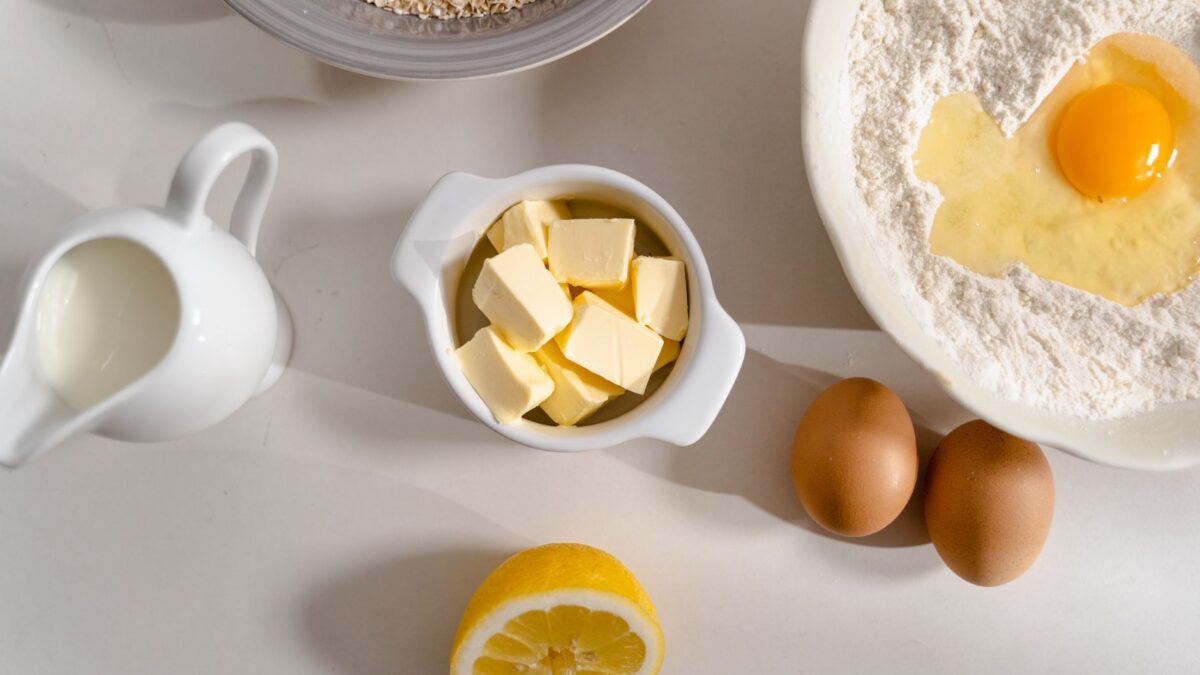
Recipes ask for room-temperature butter, eggs and dairy because ingredients at a similar, moderate temperature blend into a smooth emulsion and hold air. Softened butter traps air bubbles when beaten with sugar; cold eggs or milk added to it make the butter firm up and the batter look curdled, which leads to a denser, less even crumb. In baking, “room temperature” usually means cool to the touch, roughly 65–70°F (18–21°C), not warm or melting.
What “room temperature” means for each ingredient
| Ingredient | What you are aiming for | How to check |
|---|---|---|
| Butter | About 65–70°F (18–21°C): pliable but still holding its shape | A fingertip leaves a dent without sinking in; the stick bends without cracking |
| Eggs | No longer fridge-cold | The shell feels neutral, not cold, in your hand |
| Milk, buttermilk, yogurt, sour cream | Cool room temperature | Not cold against the inside of your wrist |
| Cream cheese | Soft enough to beat smooth without lumps | Yields easily to a spoon |
Butter that is shiny, greasy or slumping has gone too far. Overly soft butter cannot hold the air you beat into it, and cookies made with it tend to spread more. That is one of the main reasons behind cookies that spread too much.
Why it matters: the science in plain terms
Creaming needs plastic butter
In the creaming method, beating butter with sugar forces sugar crystals through the fat and creates thousands of tiny air pockets. Leavening later enlarges those pockets in the oven. Cold butter is too hard to aerate; melted butter cannot hold air at all. Butter in the cool, pliable range is what bakers call “plastic,” and that is the state creaming depends on.
Emulsions break when temperatures clash
Butter and eggs form an emulsion of fat and water. When cold eggs hit creamed butter, the butter chills, hardens into small clumps and the mixture looks curdled. The batter often still bakes, but the crumb can be coarser and the rise lower.
Cold liquids firm up melted fat
In muffin and quick bread batters made with melted butter or coconut oil, cold milk or eggs can make the fat solidify into flecks and streaks. Oil-based batters are much more forgiving, which is part of why the muffin method is so reliable.
Batter temperature affects baking
A very cold batter takes longer to heat through, so edges may set and brown before the center rises. That can contribute to peaked or uneven tops and a longer bake than the recipe states.
When it matters and when it does not
- Matters most: butter cakes, cupcakes and cookies made by creaming; cheesecake and cream cheese frosting; buttercream.
- Matters somewhat: muffins and quick breads made with melted butter, where cold liquids can resolidify the fat.
- Usually does not matter: oil-based batters, brownies made with melted chocolate (warm is fine), and most pancake batters.
- Cold is required: pie crust, biscuits and scones, where cold butter pieces create flaky layers. Do not soften butter for these.
Safe, fast ways to bring ingredients to room temperature
Butter
- Cut it up. Slice the stick into tablespoon-sized pieces and spread them on a plate. Small pieces soften in roughly 15–20 minutes, depending on your kitchen.
- Grate it. Grated cold butter softens within minutes.
- Use a warm bowl. Rinse a bowl with hot water, dry it and invert it over the butter for a few minutes.
- Microwave with care. Use very short bursts at low power and check after each one. Butter melts from the inside, so it is easy to overshoot.
Eggs
- Place whole eggs in a bowl of warm (not hot) tap water for about 5–10 minutes.
- Dry them before cracking.
Milk and other dairy
- Measure it into a microwave-safe cup and warm in short bursts, stirring, until it no longer feels cold.
- Or set the measuring cup in a bowl of warm water for a few minutes.
Food safety: how long can ingredients sit out?
US food safety agencies advise not leaving perishable foods, including eggs and dairy, at room temperature for more than 2 hours (1 hour if the room is above 90°F/32°C). See USDA FSIS food safety basics for the official guidance. In practice, the quick-warming methods above get eggs and dairy ready in minutes, so there is no reason to leave them out for hours. Return anything you do not use to the fridge promptly.
Butter is lower risk, but it can go rancid and pick up odors if left out for long periods. Soften what you need for the recipe rather than keeping a large amount on the counter.
What to do if your batter curdles
| What you see | Cause | Fix |
|---|---|---|
| Creamed butter and eggs look lumpy or split | Eggs too cold, or added too quickly | Keep mixing; add a spoonful of the recipe’s flour; or set the bowl over warm water briefly while mixing |
| Butter won’t cream, stays in hard bits | Butter too cold | Let it soften longer, or warm the bowl slightly |
| Creamed mixture looks greasy and flat | Butter too warm | Chill the bowl for 10–15 minutes, then beat again |
| White flecks of fat in muffin batter | Cold liquids hit melted butter | Usually harmless; next time warm the milk and eggs first |
Bottom line
Room temperature in baking means cool, pliable butter and eggs and dairy that are no longer fridge-cold. It matters most for creamed cakes, cookies and frostings, matters a little for melted-butter muffins, and should be ignored for pastry and scones. Warm eggs in water and cut butter into pieces to get there in minutes, and keep perishables within the 2-hour limit.
FAQ
Can I leave butter out overnight to soften?
In a warm kitchen, overnight butter is often too soft for creaming. Cutting it into pieces an hour or less before baking gives more control.
Do room-temperature eggs really make a difference in muffins?
The effect is smaller than in creamed cakes, but cold eggs can firm up melted butter. If your muffins use oil, the difference is minor.
Is it safe to warm eggs in hot water?
Use warm, not hot, water so the eggs do not start to cook, and use them right away.
What about ingredients for cold-butter recipes like scones?
Keep the butter cold. Room-temperature rules apply only when the recipe asks for softened or room-temperature ingredients.