How Much Baking Powder per Cup of Flour? Muffin, Cake, Biscuit Ratios
Use 1 to 1 1/2 teaspoons of baking powder per cup of flour for muffins and cakes, and 1 1/2 to 2 for biscuits. Ratios, scaling math and fixes.
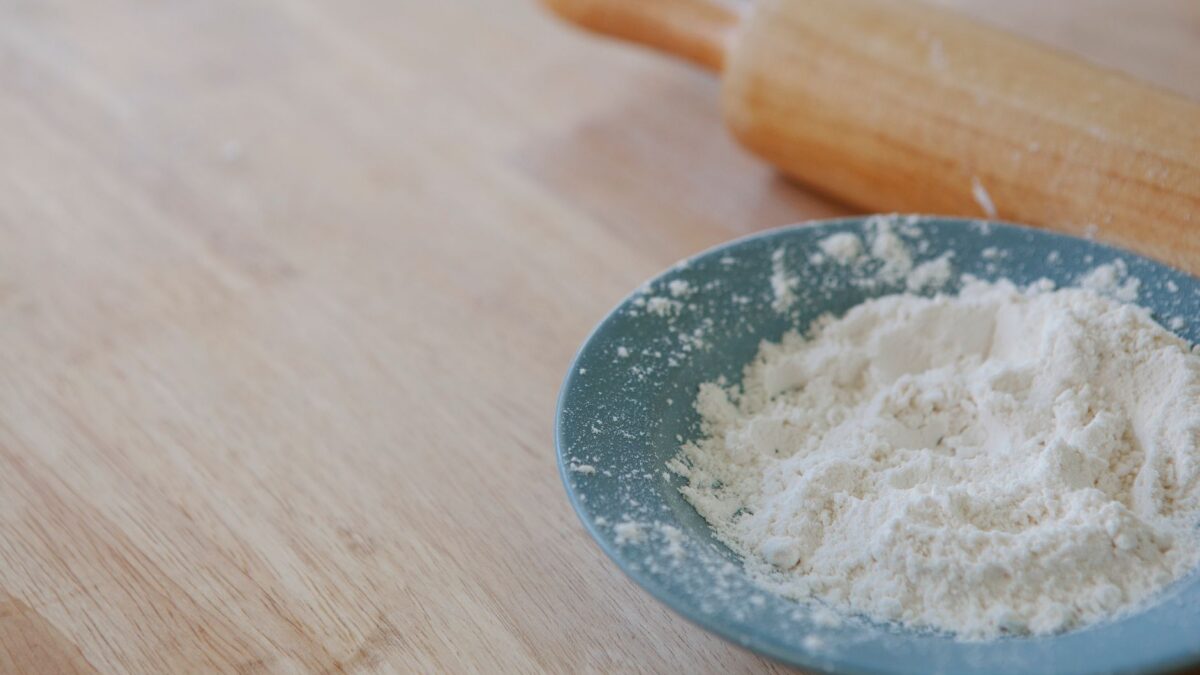
Most recipes use 1 to 1 1/2 teaspoons of baking powder per cup of all-purpose flour (about 125 g). Muffins, quick breads and cakes sit in that range, biscuits and scones go higher at 1 1/2 to 2 teaspoons per cup, and cookies need far less. One level teaspoon weighs roughly 4 g.
The range exists because each batter holds up its own gas differently. A thin cake batter, a thick muffin batter and a stiff biscuit dough all need a different amount of lift. The sections below give the numbers for each and the math for scaling a recipe up or down.
How much baking powder goes in muffins and quick breads?
Use 1 to 1 1/2 teaspoons per cup of flour (125 g), which works out to 4 to 6 g. A standard batch of 12 muffins made with 2 cups of flour usually takes 2 to 3 teaspoons.
Muffin batter is thick and heavy with fruit, nuts or chocolate chips, so it needs the upper half of that range to rise and domed tops. Quick breads such as banana bread are baked in a deep loaf pan, and the batter in the middle has to lift against its own weight. If your muffins come out flat, the baking powder fizz test and four other causes are worth checking before you add more.
How much baking powder goes in cakes and cupcakes?
Use 1 to 1 1/4 teaspoons per cup of flour. A two-layer cake with 2 1/2 cups of flour typically takes 2 1/2 to 3 teaspoons.
Cake batter is looser than muffin batter and has more sugar and fat, which means it traps air bubbles well and needs less chemical help. Too much powder in a cake makes the bubbles grow fast, break, and leave a sunken center with a coarse, crumbly texture. Butter cakes, sponge-style cakes and cupcakes all follow the same range. Recipes that rely on whipped egg whites or creamed butter for volume often sit at the low end.
How much baking powder do biscuits and scones need?
Use 1 1/2 to 2 teaspoons per cup of flour (6 to 8 g). That is the highest ratio in everyday baking, and some classic biscuit recipes use 1 tablespoon for 2 cups of flour.
Biscuit dough has no creamed fat and almost no eggs, and it is handled as little as possible. Nothing else in it traps air, so the powder does most of the lifting, and the steam from cold butter helps. Scones follow the same logic. Dough this stiff can carry the extra gas without collapsing.
How much baking powder goes in pancakes, waffles and cookies?
Pancakes and waffles use 1 to 1 1/2 teaspoons per cup of flour. Cookies need much less: usually 1/4 to 1/2 teaspoon per cup, and many drop cookies use baking soda alone or none at all.
Pancake batter is thin and cooks fast, so the gas must form quickly and the structure must set before it escapes. Cookies are meant to spread and stay dense or chewy. A little powder gives a softer, cakier crumb, and more of it makes cookies puff up and then flatten.
What if the recipe uses baking soda too?
Baking soda neutralizes acidic ingredients such as buttermilk, yogurt, brown sugar, honey, cocoa or lemon juice. The usual guideline is about 1/4 teaspoon of baking soda per cup of flour when the batter has a meaningful amount of acid, with baking powder covering the remaining lift.
When a recipe lists both, keep both. The soda handles the acid, the powder supplies the extra gas, and removing either one changes the rise, the browning and the flavor. If you need to replace baking powder entirely, see the exact ratios with baking soda, cream of tartar or buttermilk.
How do I scale baking powder when I change the flour?
Scale the powder with the flour, not with the whole batch. If a recipe calls for 2 cups of flour and 2 teaspoons of baking powder, 3 cups of flour takes 3 teaspoons. Doubling the sugar or the milk does not change the amount.
Measuring flour by weight keeps the ratio steady, since a scooped cup can weigh anywhere from 120 g to 150 g. The cups to grams converter turns any recipe into weights. Gluten-free blends are a separate case: many already contain leavening, so check the label before adding more, and read how 1:1 blends and xanthan gum behave first.
Altitude also moves the number. Above about 3,000 feet the gas expands more easily, and most recipes need a small cut in powder. The high-altitude adjustments for muffins, quick breads and cakes list the changes.
What happens with too much or too little baking powder?
Too much produces a coarse crumb, a sunken middle, and a bitter or metallic aftertaste. Too little gives a dense, heavy, pale result that barely rises.
- Too much: the batter rises quickly in the oven, then collapses as the bubbles burst before the structure sets.
- Too little: the crumb is tight and gummy, and tops stay flat.
- Old powder: the fizz is weak even at the right amount. Baking powder loses strength over time, and an opened can is generally best used within about 6 to 12 months.
To check a can, stir 1/2 teaspoon into 1/4 cup of hot water. Vigorous bubbling means it is active; little or no reaction means replace it.
Quick answers
Is baking powder per cup the same for self-rising flour?
Self-rising flour already contains baking powder and salt, commonly about 1 1/2 teaspoons of powder per cup. Do not add more unless the recipe says to.
Can I use more baking powder to make muffins taller?
Extra powder usually backfires. Past the standard range, the batter overexpands and sinks, leaving a dense, bitter muffin. Better results come from a hot oven start, a thick batter and fresh powder.
Does 1 teaspoon of baking powder weigh the same as 1 teaspoon of baking soda?
Roughly, but they are not interchangeable. Baking soda is about three to four times stronger as a leavener, so swapping them one for one ruins the recipe.
Do eggs change how much baking powder I need?
Eggs add structure and some lift. If you swap them out, the batter may need its leavening reconsidered; see the egg substitutes that work in muffins versus cakes.