How to Stop Pie Crust Edges From Burning: Shields, Foil and Timing
Stop pie crust edges from burning by covering them with a pie shield or foil ring partway through baking. When to cover, oven tweaks and crust fixes.
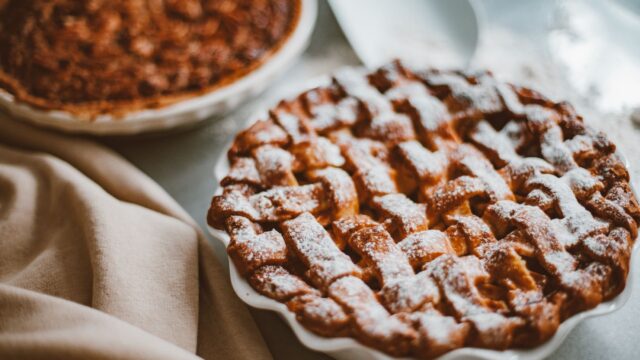
To stop pie crust edges from burning, cover the rim with a pie crust shield or a ring of aluminum foil once it reaches a light golden color, usually 15 to 25 minutes into baking. The cover keeps direct heat off the thin, exposed edge while the filling and bottom crust finish cooking. For long bakes such as pecan or deep-dish apple pie, many bakers put the shield on from the start and remove it for the last 10 to 15 minutes.
Why do pie crust edges burn before the rest of the pie?
The edge is the thinnest, most exposed part of the pie, so it cooks fastest. It sits above the filling with hot air moving around it on three sides, while the center is protected by a mass of wet fruit or custard that stays near the boiling point of water until the moisture cooks off.
Several things make the problem worse:
- A long bake. Fruit pies often need 50 to 70 minutes, and a crimp that is golden at 25 minutes will be dark brown by the end.
- Egg wash, milk or sugar brushed on the rim. Sugar and the proteins in egg brown quickly.
- A high starting temperature, such as 425°F (220°C), kept on for too long.
- The rack set too high, close to the top element.
- Dark metal pie pans, which absorb more heat than glass or light aluminum.
- A thin or uneven crimp, where some spots bake faster than others.
How do you use a pie crust shield?
A pie crust shield is a flat ring, made of aluminum or silicone, that sits on top of the crimped edge and leaves the center of the pie open. Using one is simple:
- Bake the pie uncovered until the edge turns pale golden, usually 15 to 25 minutes.
- Pull the oven rack out partway and set the shield gently on the rim with oven mitts. A metal shield that sits in the oven gets as hot as the pan.
- Finish baking with the shield in place.
- If the edge still looks pale near the end, remove the shield for the last 5 to 10 minutes.
Adjustable metal shields fit pies of different sizes. Silicone shields are easier to handle and store, but check the maker’s stated maximum temperature, since some are not meant for the hottest ovens. A shield should rest on the crust lightly. Pressing it down can flatten a decorative crimp.
How do you make a foil ring for pie crust?
A foil ring works as well as a store-bought shield and costs almost nothing. Make it before the pie goes in the oven, when your hands and the pan are cool:
- Tear off a square of aluminum foil a few inches wider than the pie dish.
- Fold it in half, then in half again, to make a smaller square.
- Cut a quarter circle from the folded corner so that, when unfolded, the hole in the middle is about 2 inches (5 cm) smaller across than the pie.
- Unfold the foil and test the fit over the unbaked pie. The ring should cover the crimp and the outer edge of the filling.
- Set the ring aside and place it over the edge partway through baking. Crimp the outer edge lightly around the rim so it stays put.
If you have no scissors handy, tear long strips of foil about 3 inches (7.5 cm) wide and wrap them around the edge, overlapping the ends. Strips are fiddly to put on a hot pie, so shape them over the cold pie first, lift them off and set them back on later. Heavy-duty foil holds its shape better than thin foil.
When should you cover the edges, and for which pies?
Cover the edges once they reach the color you want the finished crust to be. Timing depends on the type of pie:
- Double-crust fruit pies (apple, cherry, peach): cover after 15 to 25 minutes, often at the point where many recipes lower the oven from 425°F (220°C) to 375°F (190°C) or 350°F (175°C).
- Pecan pie: the filling needs a long, moderate bake, so many bakers cover the edges at the start or after 20 to 25 minutes.
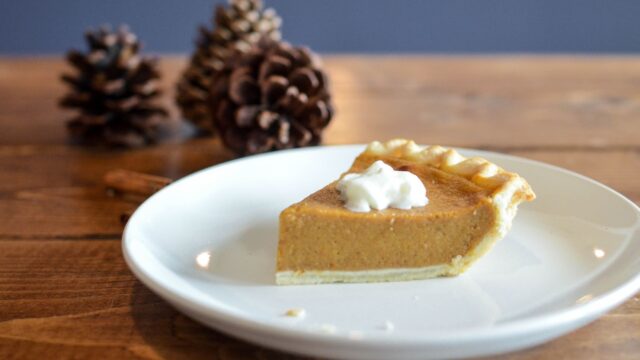
- Pumpkin and other custard pies: the bake is shorter, but a crust that was partly baked first can darken fast; check at 20 to 25 minutes and shield if needed.
- Blind-baked crusts: the edges can burn during the second, uncovered stage of baking, so a shield helps there too. Our guide on blind baking a pie crust with weights covers that stage.
Total times vary a lot between fruit, custard and nut fillings, and the chart in how long to bake a pie helps you plan when the shield should go on.
What oven changes help keep the crust edge from burning?
Bake pies in the lower third of the oven. The bottom crust gets more heat there and browns properly, and the rim sits farther from the top element. Set the pie on a rimmed baking sheet to catch drips. The sheet also takes some of the direct heat off the bottom of the pan.
Other adjustments that help:
- Use an oven thermometer. Many ovens run hot, and a pie baked 25°F (about 15°C) too hot will brown early everywhere.
- With a convection or fan setting, lower the temperature by about 25°F (about 15°C), as most oven makers advise, and check the edge sooner.
- Rotate the pie halfway through if your oven has a hot spot.
- Brush egg wash on the top crust only, or brush the rim very lightly, and keep sugar off the edge.
Can the way you make the crust prevent burnt edges?
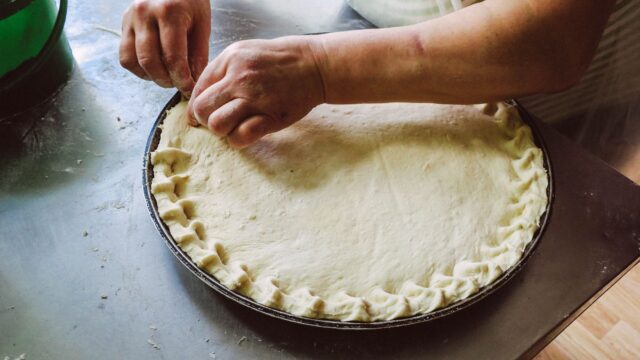
A well-made edge burns less easily. Trim the overhang to about 1/2 to 1 inch (1.5 to 2.5 cm), fold it under so the rim is an even double thickness and crimp it upright on the lip of the dish. A crimp that hangs over the outside of the pan is thin and exposed, and it can also slip and shrink. If that happens often, see why pie crust shrinks.
Chill the shaped crust for at least 30 minutes before baking so the fat stays solid and the crimp holds its shape. All-butter dough browns faster than dough made with shortening because of the milk solids in butter. The tips in all-butter pie crust from scratch explain how to keep the edge even and cold.
Quick answers
Is a slightly dark crust edge safe to eat?
A deep brown edge is safe, though it may taste bitter. Trim off any black, charred parts before serving.
Can I fix an edge that is already too dark?
Cover it right away so it darkens no further. Once baked, you can gently shave off the darkest spots with a fine grater or a small knife.
Can I use parchment paper instead of foil?
Parchment strips can work for a short time, but they are hard to keep in place and can scorch at high temperatures. Foil or a metal shield is easier to use.
How long can a baked pumpkin or custard pie sit out?
Refrigerate custard pies within 2 hours of baking, in line with the general rule for perishable foods at FoodSafety.gov. Fruit pies can stay at room temperature for a day or two.