How Long to Bake Salmon at 375, 400 and 425°F and Check Doneness
Bake 1-inch salmon fillets 15 to 20 minutes at 375°F, 12 to 15 at 400°F or 10 to 12 at 425°F. Times by thickness, doneness signs and fixes.
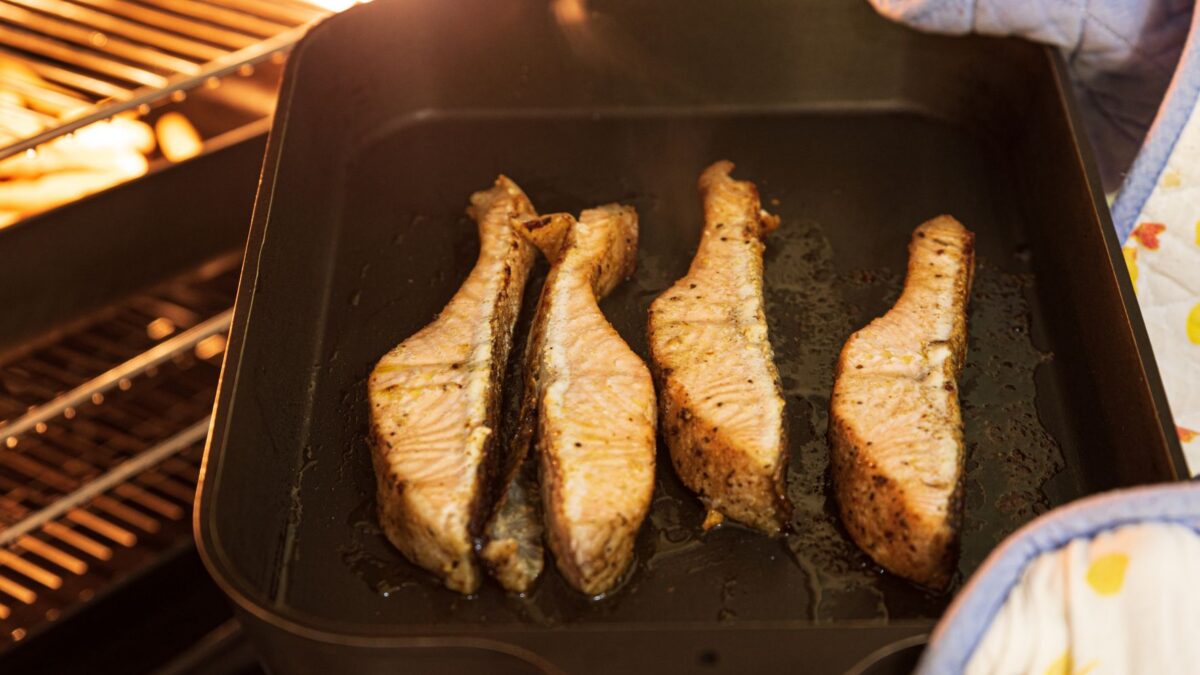
Salmon fillets about 1 inch (2.5 cm) thick bake in 15 to 20 minutes at 375°F (190°C), 12 to 15 minutes at 400°F (200°C) and 10 to 12 minutes at 425°F (220°C). The salmon is done when the thickest part reaches 145°F (63°C) on an instant-read thermometer, the USDA safe minimum for fish, and the flesh flakes easily with a fork. Thickness changes the time more than anything else, so check a few minutes before the low end of the range.
How long does salmon take at each oven temperature?
Salmon takes about 4 to 6 minutes per half inch of thickness at 400°F, and a little longer or shorter as the oven temperature drops or rises. These ranges assume fillets straight from the fridge, on a lined sheet pan, in the middle of a preheated oven:
- 375°F (190°C): thin fillets of 1/2 to 3/4 inch, 10 to 14 minutes; 1-inch fillets, 15 to 20 minutes; a whole side of salmon, 20 to 25 minutes.
- 400°F (200°C): thin fillets, 8 to 11 minutes; 1-inch fillets, 12 to 15 minutes; a whole side, 15 to 20 minutes.
- 425°F (220°C): thin fillets, 7 to 9 minutes; 1-inch fillets, 10 to 12 minutes; thick center-cut pieces of 1 1/2 inches, 14 to 16 minutes.
A convection or fan oven cooks faster. Lower the temperature by about 25°F (15°C) or start checking 3 to 4 minutes early.
Which temperature is best for salmon?
400°F (200°C) is the most common choice because it browns the top lightly and cooks the center before the thin edges dry out. 375°F (190°C) is gentler and suits a whole side of salmon or fillets baked under a sauce or crumb topping, where you want the coating and the fish to finish together. 425°F (220°C) is fast and works for thick center-cut fillets and for salmon with a glaze you want to caramelize, but thin tail pieces overcook quickly at this heat.
The same logic applies to other proteins: if you already use our guide to baking chicken breast at 350 to 425°F, salmon sits at the shorter end of every range because fish has less connective tissue.
How do you tell when baked salmon is done?
An instant-read thermometer in the thickest part of the fillet is the most reliable test. FoodSafety.gov lists 145°F (63°C) as the safe minimum internal temperature for fish. Without a thermometer, look for these signs:
- The flesh has turned from translucent deep orange to opaque pale pink all the way through.
- It separates into flakes when you press it gently with a fork.
- White droplets (albumin, a protein) start to bead on the surface. A little is normal; a thick white layer means the fish is overcooked.
Many cooks pull salmon at 125 to 135°F (52 to 57°C) for a softer, moist center. That is a personal preference; the USDA figure of 145°F (63°C) is the safety guideline, and it is the one to use for children, pregnant people, older adults and anyone with a weakened immune system.
How should you prepare salmon before baking?
Pat the fillets dry with paper towels so the surface browns instead of steaming. Brush or rub them with 1 to 2 teaspoons of oil per fillet and season with salt and pepper. Place them skin side down on a sheet pan lined with parchment or foil; the skin protects the bottom from drying out and peels off easily after baking.
Leave about an inch of space between fillets so hot air reaches every side. If the pieces differ in thickness, tuck the thin tail end under itself so the fillet bakes to an even depth.
Do not rinse raw fish in the sink. Rinsing spreads bacteria to nearby surfaces and does not make the fish safer.
Does foil or a sauce change the baking time?
Yes. Salmon wrapped in a foil or parchment packet steams in its own juices, which usually adds 3 to 5 minutes at 400°F (200°C) because the packet has to heat up first. A thin glaze such as honey and mustard barely changes the time, but sugary glazes can burn at 425°F (220°C), so brush them on during the last 5 minutes. A thick crust of breadcrumbs or a layer of sauce slows the heat slightly; check the center with a thermometer.
What about frozen salmon?
Thawed salmon bakes most evenly. Thaw it overnight in the fridge, or seal it in a plastic bag and submerge it in cold water for about an hour. Salmon can be baked from frozen: rinse off any ice glaze, pat dry, and bake at 425°F (220°C) for roughly 15 to 20 minutes for a 1-inch fillet, adding seasoning after the first 5 to 8 minutes once the surface has thawed. Always confirm 145°F (63°C) in the center.
Why did my salmon turn out dry or underdone?
Dry salmon is almost always overcooked. Fish keeps cooking for a minute or two after it leaves the oven, so take it out as soon as it reaches temperature. Thin fillets at 425°F (220°C) can pass from done to dry in about 2 minutes.
An underdone center usually means the fillets were very thick, went in cold and crowded, or the oven had not finished preheating. Return the pan to the oven and check every 2 minutes. An inexpensive oven thermometer shows whether your oven runs hot or cold; the same check helps with chicken thighs at 375, 400 and 425°F and anything else timed by temperature.
Quick answers
Should salmon be covered when baking?
Uncovered is standard for fillets on a sheet pan. Cover with foil only if the top browns before the center is done, or bake in a foil packet for a softer, steamed texture.
Do you flip salmon in the oven?
No. Bake it skin side down the whole time. Flipping breaks the fillet and is not needed because oven heat surrounds the fish.
How long does baked salmon keep?
Refrigerate leftovers within 2 hours in a covered container and eat them within 3 to 4 days. Reheat gently at 275°F (135°C) for about 15 minutes, or serve cold on salads.
How long to bake salmon at 350°F?
At 350°F (175°C), a 1-inch fillet takes about 20 to 25 minutes. The lower heat gives a very even, moist result but little browning on top.