Oven Temperature Conversions: °F to °C, Gas Marks and Fan Oven Settings
Recipes from the US, UK and Australia speak different oven languages. This chart translates them, with the fan and convection adjustments that trip people up.
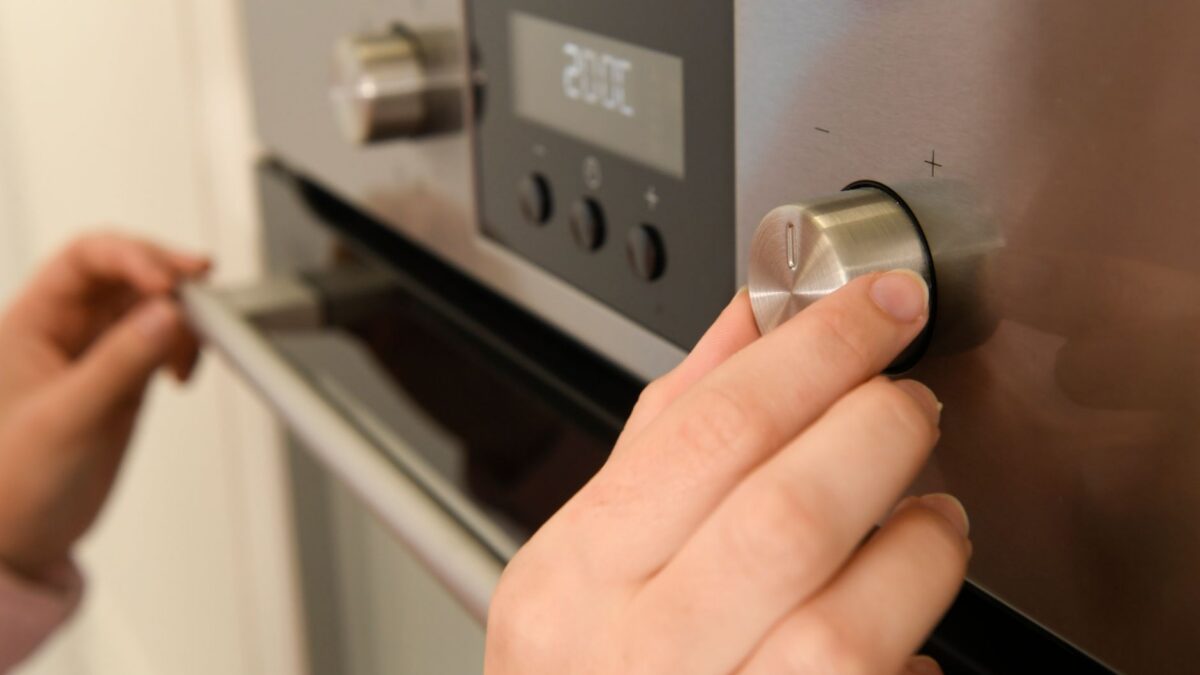
The most common baking temperature, 350°F, is 180°C or gas mark 4. In a fan (fan-forced) oven, the usual rule in the UK and Australia is to set it about 20°C lower, so 160°C fan. In the US, convection settings are usually reduced by 25°F, and many newer ovens do that automatically. The full chart is below.
Recipe temperatures are rounded. 350°F is exactly 176.7°C, but recipes write 180°C, and that small rounding never matters as much as whether your oven actually reaches the number on the dial.
Oven temperature chart
| Gas mark | °F | °C conventional | °C fan | Typical use |
|---|---|---|---|---|
| 1 | 275°F | 140°C | 120°C | Meringues, drying |
| 2 | 300°F | 150°C | 130°C | Slow-baked fruit cakes, cheesecake |
| 3 | 325°F | 160°C | 140°C | Rich or deep cakes, some cookies |
| 4 | 350°F | 180°C | 160°C | Most cakes, quick bread loaves, cookies |
| 5 | 375°F | 190°C | 170°C | Many muffins, cookies, cupcakes |
| 6 | 400°F | 200°C | 180°C | Muffins, scones, pastry |
| 7 | 425°F | 220°C | 200°C | Scones, high-start muffins, bread |
| 8 | 450°F | 230°C | 210°C | Crusty bread, pizza |
| 9 | 475°F | 240°C | 220°C | Pizza, very hot starts |
Gas mark, °F and conventional °C values follow standard UK conversion tables, such as the one published by the consumer group Which?, with the fan column 20°C lower at each step. “Typical use” is general guidance; always follow your recipe.
The formulas, if you need an exact number
- °F to °C: subtract 32, then multiply by 5 and divide by 9. Example: (400 − 32) × 5 ÷ 9 = 204.4, which recipes round to 200°C.
- °C to °F: multiply by 9, divide by 5, then add 32. Example: 190 × 9 ÷ 5 + 32 = 374, so 375°F.
For baking, round to the nearest 5 or 10 degrees your oven can be set to. Ovens commonly drift by more than that, which is why an oven thermometer is worth having; see how accurate is your oven.
Fan, fan-forced and convection: what changes
A fan oven blows hot air around the food. Moving air transfers heat faster than still air, so the surface of a cake or muffin sets and browns sooner. If you bake at the conventional temperature with the fan on, the outside can overbake or dome and crack before the middle is done.
UK, Ireland, Australia and New Zealand
Recipes often give two figures, such as “180°C (160°C fan)”. If only one is given, check the recipe’s notes. Which? points out that because most UK ovens are fan-assisted, a single temperature in a modern recipe often already refers to the fan setting. When in doubt, look at the source’s introduction or test the first batch early.
United States and Canada
American recipes almost always assume a conventional (non-fan) bake setting. For convection bake, the standard adjustment is to lower the temperature by 25°F, keep roughly the same time and start checking for doneness a few minutes early. Several manufacturers build this in: GE owner’s manuals and LG’s range support guide describe an automatic conversion feature that subtracts 25°F when convection bake is selected. Check your manual so you do not reduce the temperature twice. More detail is in our convection oven baking guide.
Other oven settings you may see
- Top and bottom heat (often shown as two lines on European ovens) is the conventional setting most cake recipes assume when no fan is mentioned.
- Fan with bottom heat is sometimes recommended by manufacturers for pizza or pastry with a crisp base. Check your oven’s manual for its intended uses.
- Air fry modes on ranges and countertop ovens use a strong fan. Treat them like convection, and expect faster browning on muffin and cake tops.
- Older recipes sometimes say “moderate oven” (roughly 350°F, 180°C, gas mark 4), “moderately hot” (around 375–400°F) or “hot” (around 425–450°F). These are loose terms; pick a temperature in the range and watch closely.
Quick decision rules
- US recipe, conventional oven: use the °F given, or the °C equivalent from the chart.
- US recipe, fan or convection oven: reduce by 25°F (about 15°C) unless your oven converts automatically.
- UK or Australian recipe with a fan figure: use the fan figure if your fan is on, the higher figure if it is off.
- Gas oven recipe in an electric oven: use the °C or °F column for that gas mark. Some bakers using a fan gas oven drop one gas mark instead.
- Delicate bakes in a fan oven (tall cakes, cheesecake, custards): many bakers switch the fan off if the oven allows it, since strong airflow can tilt or crack the top.
Common muffin and cake temperatures
| Bake | Conventional | Fan / convection |
|---|---|---|
| Standard muffins | 375–400°F (190–200°C) | 350–375°F (170–180°C) |
| Hot start for domed muffins | 425°F (220°C), then lower | 400°F (200°C), then lower |
| Layer cakes, cupcakes | 350°F (180°C) | 325°F (160°C) |
| Quick bread loaves | 350°F (180°C) | 325°F (160°C) |
| Drop cookies | 350–375°F (180–190°C) | 325–350°F (160–170°C) |
These are typical ranges, not rules. Size changes time much more than temperature does; our muffin bake time chart lists times for mini, standard and jumbo cups.
Bottom line
Memorize one anchor: 350°F equals 180°C equals gas mark 4. Each gas mark step is 25°F, or about 10–20°C. With the fan on, go 20°C lower for UK and Australian recipes, or 25°F lower for American ones, unless your oven already does it for you. Then trust doneness cues, not the clock.
FAQ
What is 180°C in Fahrenheit?
Exactly 356°F, which recipes treat as 350°F, or gas mark 4.
Is 180°C fan the same as 200°C conventional?
Roughly, yes. A fan oven at 180°C bakes much like a conventional oven at about 200°C, which is why fan settings are 20°C lower.
Do I need to change the baking time in a fan oven?
If you lower the temperature, the time usually stays about the same, though bakes may finish a little sooner. Start checking a few minutes before the recipe’s earliest time.
What gas mark is 375°F?
Gas mark 5, which is 190°C conventional or about 170°C fan.