Baking in a Convection or Air-Fry Oven: Temperature, Time and What Works Best
A fan changes how heat reaches your muffins and cookies. Here is how to adjust recipes and when to switch the fan off.
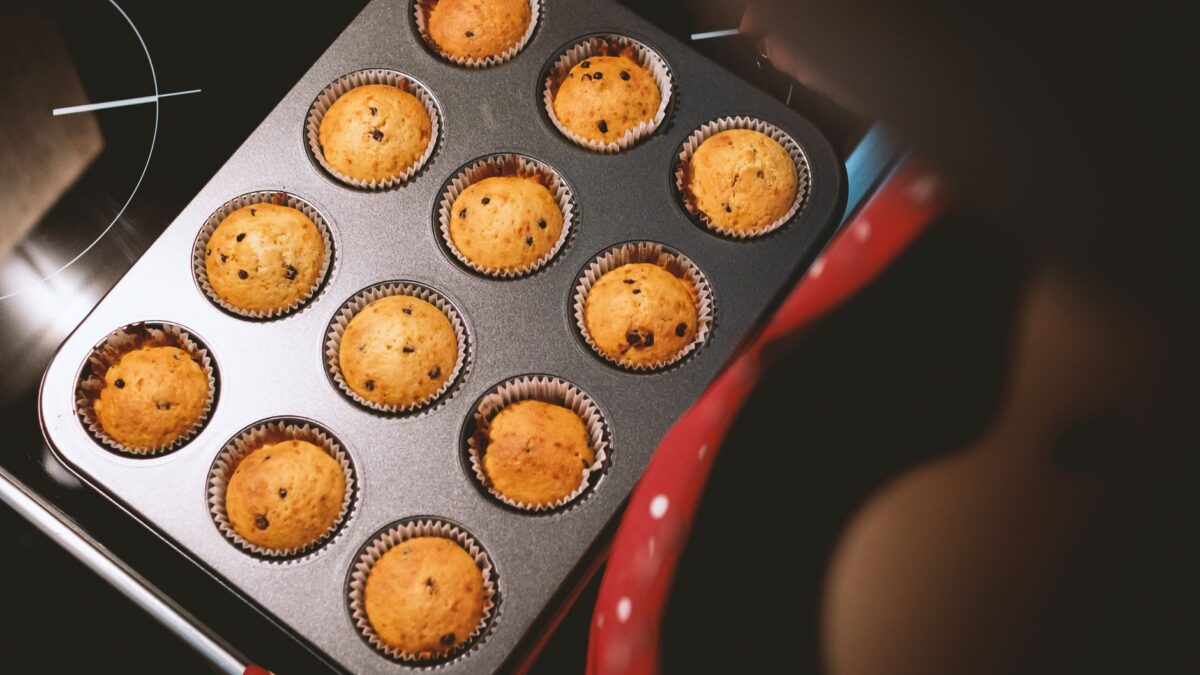
A convection oven uses a fan to move hot air around the food, so baked goods brown and set faster. The standard adjustment for US recipes is to lower the temperature by about 25°F (about 15°C) and start checking for doneness a few minutes early. Many newer ovens make this change automatically. Cookies, muffins, scones and multi-rack batches do well with the fan; delicate custards, soufflés and tall cakes are often better without it.
This guide explains what the fan does, how to convert recipes, which bakes suit convection and how air-fry ovens fit in.
What the fan actually does
In a conventional oven, heat rises from the elements and the air around the food is fairly still. A thin layer of cooler air clings to the surface of the batter and slows heat transfer. A convection fan keeps sweeping that layer away, so heat reaches the surface faster and more evenly. The results:
- Faster browning and crisping.
- Shorter bake times, in many cases.
- More even heat across racks, which makes multi-rack baking practical.
- Faster drying of the surface, which can be good (crisp cookie edges) or bad (cracked cheesecake).
Some ovens heat the air with the regular elements and simply add a fan. Others, often labeled “true” or “European” convection, have a third element around the fan. Both follow the same general rules; your manual gives model-specific advice.
How to convert a recipe
- Check whether your oven converts automatically. LG’s range support guide, for example, describes convection modes that lower the set temperature by 25°F (14°C) on their own, so a 350°F setting shows 325°F after preheating. Other brands do the same. If yours does, do not subtract again.
- If it does not, lower the temperature by about 25°F. For recipes written for UK or Australian fan ovens, the temperature given is usually already adjusted.
- Keep the time as a guide, but check early. Start checking about three-quarters of the way through the stated bake time.
- Use the same doneness cues: a clean toothpick, a springy top and, for loaves, an internal temperature of about 200–205°F (93–96°C).
Conversion table
| Recipe says (conventional) | Convection (US, about 25°F lower) | UK/AU fan (about 20°C lower) |
|---|---|---|
| 325°F (160°C) | 300°F | 140°C |
| 350°F (180°C) | 325°F | 160°C |
| 375°F (190°C) | 350°F | 170°C |
| 400°F (200°C) | 375°F | 180°C |
| 425°F (220°C) | 400°F | 200°C |
For gas marks and a fuller chart, see oven temperature conversions.
Which bakes suit convection
| Bake | Convection? | Why |
|---|---|---|
| Drop cookies, multiple sheets | Yes | Even baking across racks, crisp edges |
| Muffins | Usually yes | Good browning; watch that tops do not set before rising |
| Scones and biscuits | Yes | Quick rise and golden tops |
| Pie crust, puff pastry | Often yes | Flaky, well-browned crust |
| Roasted vegetables | Yes | Crisper surfaces |
| Layer cakes, quick bread loaves | Sometimes | Crust can set early and cause domes or cracks; many bakers prefer the fan off |
| Custards, cheesecake, soufflé | Usually no | Surface dries and cracks; gentle heat is better |
| Very light batters (chiffon, sponge) | Often no | Fan can push batter or set it lopsided |
If convection muffins come out with lower domes, the fan may be setting the surface before the batter finishes rising. Try the conventional setting with a hot start; the method is explained in how to get tall muffin tops.
Multi-rack baking
Convection is at its best when you have two or three sheets of cookies at once. Space the racks evenly, leave room around each pan for air to move, and rotate pans if your oven has a strong back-to-front difference. Multi-rack loads can lengthen bake time slightly compared with a single sheet, so check rather than rely on the clock.
Air-fry ovens and countertop air fryers
Air-fry modes and countertop air fryers are compact convection ovens with strong fans close to the food. They are designed for crisping, so they brown surfaces quickly. For baking in them:
- Follow the appliance manual first; many give baking temperatures.
- Bakers commonly start about 25°F lower than a conventional recipe and check early.
- Use small pans or silicone cups that fit with space for airflow.
- Cover tops loosely with foil if they brown before the center is done, but secure the foil so the fan cannot lift it.
- Bake small batches; overcrowding blocks the airflow.
Troubleshooting
| Problem | Likely cause | Fix |
|---|---|---|
| Dark tops, raw middles | Temperature not reduced; oven runs hot | Lower 25°F; check with an oven thermometer |
| Lopsided cakes | Fan pushing batter | Use conventional bake |
| Dry edges | Overbaking | Check earlier; reduce time |
| Uneven trays | Overcrowded racks | Space pans; rotate halfway |
An oven thermometer shows whether the fan setting changes your oven’s real temperature; see the oven thermometer guide.
Bottom line
Lower conventional recipes by about 25°F for convection, unless your oven already does it, and check early. Use the fan for cookies, scones, pastry and multi-rack baking; switch it off for custards, cheesecakes and delicate cakes. Treat air fryers as small, strong convection ovens.
FAQ
Should I reduce both time and temperature?
Reduce the temperature and start checking early. Cutting both at once can leave centers underbaked.
How do I know if my oven auto-converts?
Check the manual or watch the display after selecting convection bake. If the set temperature drops on its own, it converts.
Is fan forced the same as convection?
Yes. “Fan” and “fan forced” are UK and Australian terms for convection ovens.
Can I bake muffins in an air fryer?
Yes, in small batches with silicone cups or a small pan. Lower the temperature and check early.