How to Plan a Christmas Cookie Exchange: Quantities, Packaging and Allergen Labels
A cookie exchange is simple math plus a few house rules. Decide how many cookies each guest brings, ask for allergen labels and pick cookies that survive a car ride.

A cookie exchange works when every guest knows three things in advance: how many cookies to bring, what kind of cookie travels well, and how to label ingredients. A simple rule is that each guest bakes half a dozen cookies per participant plus one extra dozen for tasting at the party, brings them in a sturdy container and attaches a card listing the cookie’s name and its major allergens. Everyone goes home with a mixed box of the same size they brought.
The details below cover group size, timing, packaging, labels and a few rules that save confusion on the day.
How many cookies should each person bake?
The number scales with the guest list. Most hosts settle on 6 cookies per participant to take home, then add a dozen for sampling.
| Participants | Cookies each guest bakes (6 per person to take home) | Plus tasting plate | Total per guest |
|---|---|---|---|
| 6 | 36 (3 dozen) | 12 | 48 (4 dozen) |
| 8 | 48 (4 dozen) | 12 | 60 (5 dozen) |
| 10 | 60 (5 dozen) | 12 | 72 (6 dozen) |
| 12 | 72 (6 dozen) | 12 | 84 (7 dozen) |
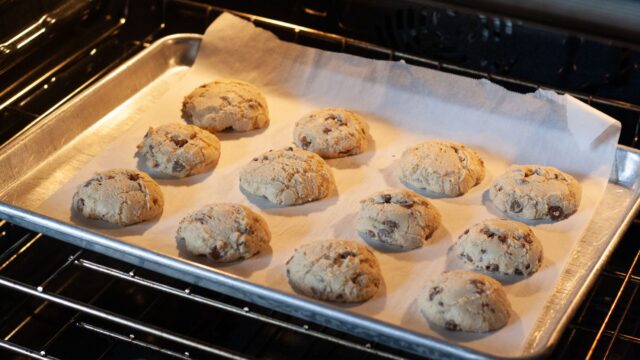
Above about 12 people the baking load gets heavy. Either cap the group or reduce the take-home amount to 3 or 4 cookies per person. Most standard drop-cookie recipes, such as chocolate chip cookies, make roughly 3 to 4 dozen per batch, so a guest in a group of 8 can usually get there with a batch and a half.
A planning timeline
- 3 to 4 weeks before: pick a date (early to mid December works well), send invitations and set the cookie count.
- 2 weeks before: ask guests to name their cookie so there are no duplicates. A shared list or group message is enough.
- 1 to 2 weeks before: guests can bake and freeze sturdy cookies, or freeze dough, then bake closer to the day. See how to freeze Christmas cookies.
- 1 to 2 days before: bake or thaw, decorate and package.
- On the day: set up a long table, labels, extra containers and drinks.
Which cookies work best
The best exchange cookies are sturdy, keep for several days at room temperature and stack without sticking.
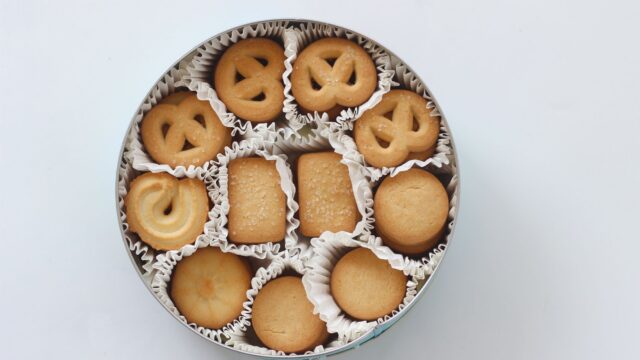
- Great choices: sugar cookies with dried royal icing or sanding sugar, gingerbread, shortbread, snickerdoodles, chocolate crinkles, biscotti, oatmeal cookies, thumbprints with jam, brownies and blondies cut into squares.
- Use with care: soft frosted cookies (need layers of parchment), very thin lace cookies (break easily), chocolate-dipped cookies in a warm room.
- Usually avoid: anything with cream cheese frosting, custard, whipped cream or cream fillings that need refrigeration, and very delicate meringues.
Recipes that suit an exchange: cut-out sugar cookies and gingerbread cookies.
Packaging
- Ask every guest to bring cookies already divided into bags or boxes of six, or to bring them on one big tray plus an empty container to fill. Pre-packed is faster; a tray is more fun to pick from.
- Clear cellophane bags tied with ribbon work for sturdy cookies. Small boxes or tins lined with parchment protect decorated or fragile ones.
- Separate layers with parchment or wax paper, especially for iced cookies.
- Keep strong flavors apart. Peppermint and gingerbread can scent everything around them; wrap them separately.
- Pack crisp and soft cookies in different containers so the crisp ones stay crisp.
- Cool cookies completely before packing. Warm cookies steam inside bags and go soft or sticky.
Allergen labels
A short, honest label makes the swap safer for everyone and is one of the most useful house rules. Each card should list:
- The name of the cookie.
- The major allergens it contains. In the US, the major food allergens are milk, eggs, fish, crustacean shellfish, tree nuts, peanuts, wheat, soybeans and sesame. For cookies, the common ones are wheat, eggs, milk, tree nuts, peanuts, soy and sesame.
- A note when the cookie was made in a kitchen that also handles peanuts or tree nuts, since cross-contact is possible in home baking.
- Whether the cookie needs refrigeration (ideally none should).
A sample card: Gingerbread stars. Contains: wheat, eggs, milk. Made in a kitchen that uses tree nuts.
The US Food and Drug Administration publishes the official list of major food allergens. In the UK, the Food Standards Agency lists 14 allergens; guests can follow their own country’s list.
If a guest has a serious allergy or celiac disease, a home cookie swap cannot guarantee allergen-free cookies. They may prefer to bring and take home only cookies they know are safe for them. Gluten-free or nut-free cookies need certified ingredients and clean equipment; anyone with a medical condition should follow their doctor’s or dietitian’s advice.
House rules that help
- Homemade only, or decide in advance whether store-bought is welcome for busy guests.
- One recipe per guest, registered ahead to avoid five batches of chocolate chip.
- Bring recipe cards or share recipes by message afterward.
- No raw dough to taste or to swap unless it is clearly labeled for baking. Raw cookie dough contains raw flour and usually raw eggs; it should be baked, not eaten raw.
- Extra containers on the host’s table for anyone who forgets.
Running the swap
- Each guest sets their cookies and label on the table as they arrive.
- After a tasting round, guests walk the table in turn, taking their share of each cookie.
- Leftover tasting cookies can go home with the host or to a neighbor, shelter or workplace break room.
Bottom line
Set the number early (six per participant plus a tasting dozen is a reliable starting point), steer guests toward sturdy, shelf-stable cookies, pack them cooled and layered, and ask for a simple allergen card with every batch. The planning takes ten minutes; the cookies do the rest.
FAQ
How many people should be in a cookie exchange?
Six to twelve is a comfortable range. Fewer means less variety; more means a very large baking load for each guest.
Can I bring store-bought cookies?
That is up to the host. Many swaps are homemade only, but allowing a store-bought option can make it easier for busy guests to join.
How far ahead can I bake for a cookie swap?
Sturdy cookies can be baked one to two weeks ahead and frozen, then thawed in a closed container the day before.
What is the most important label information?
The cookie’s name and its major allergens, plus a note about possible cross-contact with nuts.